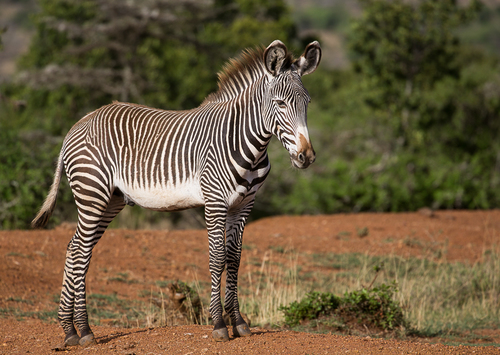
Grévy's Zebra
Equus grevyi
Meet the imperial Grévy's zebra, the largest and most striking of all wild equids. With its oversized ears and razor-thin stripes, this endangered icon of the African scrub is a masterpiece of desert evolution.
Quick Identification
Size
Shoulder height of 1.45 to 1.6 meters (4.8 to 5.2 feet); total length up to 3 meters (9.8 feet); weighs between 350 and 450 kilograms (770 to 990 pounds).
Colors
Features numerous thin, vertical black and white stripes that extend to the hooves but stop at a clear white belly. They possess a distinctive brown muzzle and a thick, dark dorsal stripe.
Key Features
- Extremely large, rounded mule-like ears
- Very narrow, closely spaced vertical stripes that do not wrap around the belly
- Distinctively erect, tall mane and a slender, elongated snout
When You’ll See Them
Sightings on EverydayEarth
Aug 2, 2026
A single Grevy's zebra stands in a dry, grassy woodland clearing. It remains relatively still at first, looking towards the camera before lowering its head to graze on the parched vegetation.
Jul 31, 2026
A small herd of Grevy's zebras is seen walking across a dry, open landscape. Several individuals cross a dirt path in the foreground while others graze in the background near some trees.
Jul 31, 2026
A group of Grevy's zebras is gathered in a woodland clearing; three stand alert while a fourth rests in the grass. Their large ears twitch as they monitor their surroundings. In the distance, a Reticulated Giraffe is visible moving through the brush behind the zebras.
Jul 31, 2026
A small group of Grevy's zebras are grazing in a dry woodland clearing. One zebra is prominently visible in the foreground, steadily feeding on the low grass, while two others are partially obscured by the brush in the background.
Jul 31, 2026
A Grévy's zebra grazes on dry grass in a woodland clearing. It slowly lowers its head to feed, occasionally flicking its tail and moving its ears to monitor its surroundings.
Jul 31, 2026
A Grevy's zebra is seen grazing in a woodland clearing. It moves slowly across the frame from left to right, focusing its attention on the low vegetation near a row of wooden posts before turning to show its full side profile.
Geographic range
Where Does the Grévy's Zebra Live?
Native to the Horn of Africa, the Grévy's zebra is currently found primarily in Northern Kenya and isolated pockets of Ethiopia. This species has seen a significant range contraction over the last century, making it one of the rarest wild equids on the planet. While historically found in Somalia and Djibouti, modern populations are now concentrated in the dry, scrubby landscapes of the Kenyan rangelands.
Basemap © OpenStreetMap contributors
Recorded on EverydayEarth
Behavior
Grévy's zebras exhibit a unique social structure compared to other equids. Unlike the stable harem groups seen in Plains zebras, Grévy's live in much more fluid associations. Territorial males claim large areas, often near water sources, hoping to attract passing females. These associations are often temporary and based on resource availability, though nursing mothers and their foals form the most stable social units within the population.
These zebras are highly vocal and communicate through a series of loud, deep grunts and bellows that sound more like a donkey's bray than a horse's whinny. While generally peaceful, territorial stallions can be fiercely protective of their boundaries, engaging in ritualized displays, neck-wrestling, or physical bouts to maintain dominance. In the presence of potential threats, they are remarkably alert, using their massive ears to pinpoint distant sounds across the arid plains.
EverydayEarth exclusive
Camera Tips
Capturing the imperial Grévy's zebra requires strategic placement, as these animals are highly mobile and range over large, arid territories. Because they are more water-dependent than many other desert dwellers, the most successful camera trap locations are within 100 meters of permanent water holes or along well-worn game trails leading to these life-giving spots. Position your camera approximately 1.2 to 1.5 meters (4 to 5 feet) high to capture the full profile of this large equid, ensuring the lens is slightly angled downward to accommodate the zebra's distinctive leg markings.
While salt licks can act as a natural lure in some regions, the best results come from understanding their movement patterns. During the heat of the day, they often seek shade under large Acacia trees, making these 'loafing areas' excellent secondary locations. Ensure your camera has a fast trigger speed (0.5 seconds or less) to catch them as they walk by, and set a 'recovery time' of at least 30 seconds to avoid hundreds of photos of a resting herd or a single individual standing near the lens.
Because Grévy's zebras are active both day and night, use a camera with high-quality No-Glow infrared flash to avoid spooking the animals after dark. Their stripes create high-contrast patterns that can sometimes 'blow out' or overexpose in bright sunlight or with strong flashes. If your camera allows for exposure adjustment, set it slightly lower (-0.5 or -1.0) to preserve the intricate detail in their unique stripe patterns. Seasonal timing is also key; the dry season is the absolute best time for sightings as animals congregate predictably near the few remaining permanent water sources.
Similar Species
Species that look similar or are commonly confused with Grévy's Zebra.
Frequently Asked Questions
Record Grévy's Zebra at your habitat
Connect a camera to start building your own species record — AI identifies every visitor automatically.