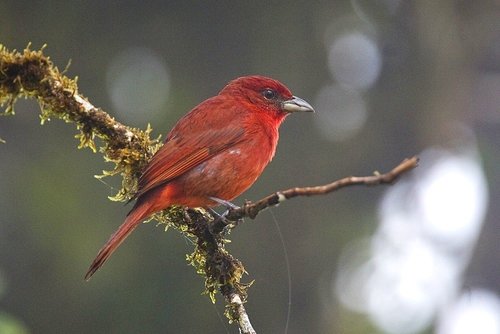
Hepatic Tanager
Piranga flava
A striking resident of the mountain pine-oak forests, the Hepatic Tanager is distinguished by its deep brick-red plumage and steady, methodical nature. Unlike its brighter cousins, this bird carries the subtle tones of the earth, blending perfectly into the shadows of the high canopy.
Quick Identification
Size
Length: 17–20 cm (6.7–7.9 in); Wingspan: 31–32 cm (12.2–12.6 in); Weight: 23–48 g (0.8–1.7 oz)
Colors
Males are a deep brick-red with grayish wash on the back and cheeks; females are olive-yellow with gray cheek patches and dark bills.
Key Features
- Brick-red or liver-colored plumage in males
- Stout, dark bill with a slight hook
- Grayish cheek patches and ear coverts
- Slow, deliberate foraging movements high in the canopy
- Low, dry 'chup' call note
When You’ll See Them
Geographic range
Where Does the Hepatic Tanager Live?
The Hepatic Tanager is a wide-ranging bird of the Americas, found from the southwestern United States through the highlands of Mexico and Central America, extending deep into South America as far as Argentina. In the U.S., it is a summer resident primarily in Arizona and New Mexico, while populations from central Mexico southward are generally year-round residents of their tropical and subtropical mountain homes. They are a classic species of the 'sky islands'—the isolated mountain ranges that rise out of the desert floor.
Basemap © OpenStreetMap contributors
Behavior
The Hepatic Tanager is known for its deliberate and steady behavior, often appearing more sluggish than the frenetic warblers that share its habitat. It spends the majority of its time in the upper reaches of the forest canopy, moving methodically through the branches to glean insects from the undersides of leaves. While not overtly social with other species, they are frequently seen in pairs, maintaining contact with short, dry call notes that sound like 'chup' or 'chuck'.
During the breeding season, males sing a rich, flute-like song from high perches, which can easily be mistaken for a Black-headed Grosbeak or an American Robin. Despite their bright colors, they can be surprisingly difficult to spot against the mottled light of a pine-oak forest. Their interaction with humans is usually limited to backyard sightings in high-elevation neighborhoods where they may descend to visit water features or fruit-bearing trees.
EverydayEarth exclusive
Camera Tips
To capture high-quality footage of a Hepatic Tanager, your best strategy is to focus on water. Because they are canopy-dwellers, they rarely come to the ground except to drink or bathe. Installing a bird bath with a solar-powered fountain or a simple dripper is highly effective. Place your AI-powered camera 3 to 4 feet away from the water source at a slight upward angle. This positioning helps distinguish the Hepatic Tanager from its relatives by capturing the dark color of the bill and the grayish wash on the cheeks, which are key identifying markers.
If you are using a trail camera, mount it on a tree trunk overlooking a platform feeder at a height of about 5 to 6 feet. While they aren't traditional seed-eaters, they are often tempted by fruit. Halved oranges, dark grapes, or even suet mixed with dried berries can draw them down from the high pines. Ensure your camera is set to a high-resolution video mode with a fast trigger speed, as their visits to the feeder can be brief before they retreat back into the safety of the foliage.
Lighting is critical for this species because the male's brick-red feathers can appear dark or brownish in deep shade. Try to position your camera and feeder in an area that receives dappled morning light. Avoid direct midday sun, which can wash out the subtle gray tones that define the species. In the southwestern U.S., the best time for camera activity is during the 'monsoon' season in July and August, when the birds are most active and water sources become social hubs for local wildlife.
Similar Species
Species that look similar or are commonly confused with Hepatic Tanager.
Summer Tanager
Summer Tanagers are a brighter, more uniform rose-red and have a noticeably pale, horn-colored bill.
Scarlet Tanager
Scarlet Tanagers have jet-black wings and tails that contrast sharply with their brilliant red bodies.
Western Tanager
Western Tanagers have bright yellow bodies with a red face and prominent white and yellow wing bars.
Frequently Asked Questions
Record Hepatic Tanager at your habitat
Connect a camera to start building your own species record — AI identifies every visitor automatically.