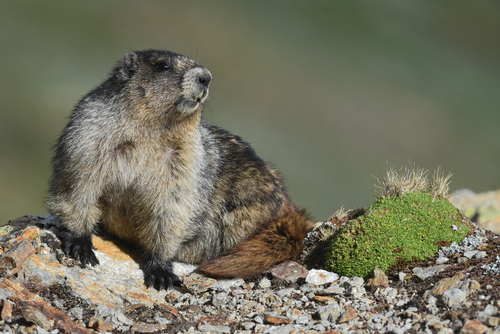
Hoary Marmot
Marmota caligata
The legendary 'whistler' of the high peaks, the Hoary Marmot is a social giant of the alpine world. These silver-furred sentinels are the masters of the mountain talus, spending their short summers feasting and basking before a long winter's sleep.
Quick Identification
Size
62-82 cm (24-32 in) in length; weighs between 3.7-10 kg (8-22 lbs)
Colors
Silvery-gray fur on shoulders and back, black cap on head, white patch on snout, and dark brown or black feet.
Key Features
- Silvery-white 'hoary' fur on shoulders and upper back
- Black cap on head with a distinct white patch between the eyes
- Large, heavy-set body with a bushy reddish-brown tail
- Loud, high-pitched whistling alarm call
When You’ll See Them
Geographic range
Where Does the Hoary Marmot Live?
The Hoary Marmot is native to the rugged mountain ranges of northwestern North America. Its core range extends from the northern reaches of Alaska and the Yukon Territory through the mountainous regions of British Columbia and Alberta. In the United States, they are commonly found throughout the Cascade and Olympic Mountains of Washington and southward into the northern Rocky Mountains of Idaho and Montana.
Basemap © OpenStreetMap contributors
Behavior
Hoary Marmots are highly social animals that live in colonies organized around a dominant male, several breeding females, and their subordinate young. They are famously nicknamed 'the whistler' due to their ability to emit a piercing, high-pitched alarm call that alerts the entire colony to the presence of predators like eagles or grizzly bears. Much of their day is spent alternating between intensive foraging in alpine meadows and basking on large boulders, which they use as lookout posts.
Because they live in harsh high-altitude environments, Hoary Marmots are master hibernators. They spend up to eight months of the year in deep underground burrows, entering a state of torpor from late September until the spring thaw in May. During the short summer growing season, they must double their body weight to survive the winter. They are generally wary of humans but can become surprisingly bold around mountain campsites, where they may chew on gear to obtain salt from human sweat.
EverydayEarth exclusive
Camera Tips
To capture the best Hoary Marmot footage, look for 'sentinel rocks'—the largest, flattest boulders in a talus field that show signs of frequent use, such as smoothed surfaces or nearby droppings. Marmots love to sun themselves on these rocks while keeping watch. Position your camera at a low angle, roughly 12 inches off the ground, aimed at the top of the boulder to get eye-level shots of them basking or grooming.
Since these are diurnal animals, high-quality daytime triggers are essential. Set your camera for 'burst mode' or short video clips, as marmots often engage in social play or 'wrestling' matches that are best captured in motion. Avoid placing cameras in deep shadows; marmots prefer sunny spots, so ensure your camera is positioned to handle high-contrast alpine light without washing out their silvery fur.
Because the Hoary Marmot's active season is so short, deployment timing is critical. Aim to have your cameras out as soon as the snow begins to melt in May or June. These animals are naturally curious and may investigate the camera lens, so using a protective housing or a sturdy mount is recommended. Do not use salt as a lure, as it can encourage damaging behavior toward the camera equipment and disrupt their natural mineral-seeking patterns.
Similar Species
Species that look similar or are commonly confused with Hoary Marmot.
Frequently Asked Questions
Record Hoary Marmot at your habitat
Connect a camera to start building your own species record — AI identifies every visitor automatically.