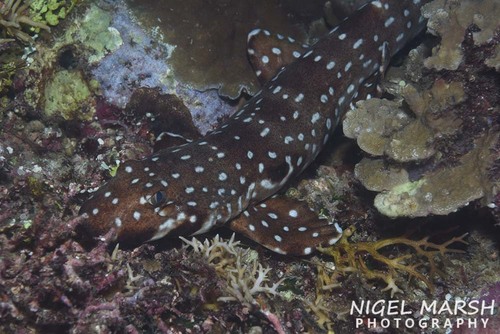
Hooded Carpetshark
Hemiscyllium strahani
The Hooded Carpetshark is a rare 'walking' shark found only in the reefs of Papua New Guinea. With its distinctive dark mask and incredible ability to crawl across the sea floor, it is one of the ocean's most unique nocturnal wonders.
Quick Identification
Size
Up to 75 cm (29.5 inches) in total length
Colors
Tan or light brown base with numerous dark spots and white-centered ocelli; distinguished by a dark, hood-like mask covering the head and gill region.
Key Features
- Dark brown 'hood' covering the head and gills
- Muscular, paddle-like pectoral and pelvic fins used for 'walking'
- Small, slender body with a long, thick tail
- White-ringed dark spots scattered across the body
When You’ll See Them
Geographic range
Where Does the Hooded Carpetshark Live?
The Hooded Carpetshark is a highly localized species native to the Western Pacific, specifically the tropical waters surrounding Papua New Guinea. Its core range is restricted to the northern coastlines and the Bismarck Archipelago, where it inhabits the vibrant coral reef systems of the Solomon Sea. Unlike many wider-ranging marine species, this shark is a resident specialist that does not migrate, spending its entire life cycle within a very narrow geographic corridor.
Basemap © OpenStreetMap contributors
Behavior
The Hooded Carpetshark is a master of the nocturnal reef environment, known for its unique 'walking' locomotion. Rather than swimming through open water, it uses its thick, muscular pectoral and pelvic fins to crawl across the sea floor and navigate the complex structures of coral reefs. This specialized movement allows it to squeeze into tight crevices and even move across exposed reef flats during low tide, surviving briefly out of water by slowing its metabolism.
By day, this shark is incredibly secretive, hiding deep within reef cracks or under large coral heads to avoid predators. At night, it becomes an active hunter, utilizing electro-receptors in its snout to detect the faint electrical signals of prey hiding in the sand. While generally docile and harmless to humans, they are shy and will quickly retreat into the reef if startled by bright lights or sudden movements.
EverydayEarth exclusive
Camera Tips
Capturing the Hooded Carpetshark requires specialized underwater equipment, as these sharks are strictly benthic and nocturnal. To see them, place an underwater trail camera or a stationary drop-cam near the base of a reef slope or near prominent coral 'bommies' where crevices are abundant. The camera should be angled slightly downward toward the sandy patches adjacent to the reef, as this is where the sharks often 'walk' while searching for food.
Because they are active in total darkness, a camera with high-quality infrared (IR) or low-glow LEDs is essential. While white light can capture their beautiful spotted patterns, it often startles them, causing them to retreat. If using white light, consider a motion-activated trigger with a slight delay to allow the shark to settle into the frame. Setting the camera to record short video clips (15-30 seconds) is far more effective than still photos, as the unique 'walking' gait of this species is its most fascinating characteristic.
Attracting this species for the camera can be done using a perforated scent container filled with oily fish like sardines or chopped crustaceans. Secure the bait box firmly to a rock or a weight to prevent it from drifting or being carried off by larger predators. In terms of timing, the best footage is usually captured during the rising tide at night, when the sharks move from deep reef shelters into shallower flats to forage. Ensure your camera housing is rated for at least 20 meters and check the seals regularly to prevent salt-water ingress.
Similar Species
Species that look similar or are commonly confused with Hooded Carpetshark.
Epaulette Shark
Lacks the dark 'hood' over the head and instead features a large, prominent black spot (ocellus) just behind the pectoral fins.
Speckled Carpetshark
Has a much finer, denser pattern of small spots and lacks the dark head mask of the Hooded Carpetshark.
Indonesian Bamboo Shark
Found in different geographic waters and features distinct dark bands or saddles rather than the 'hood' and ocelli pattern.
Frequently Asked Questions
Record Hooded Carpetshark at your habitat
Connect a camera to start building your own species record — AI identifies every visitor automatically.