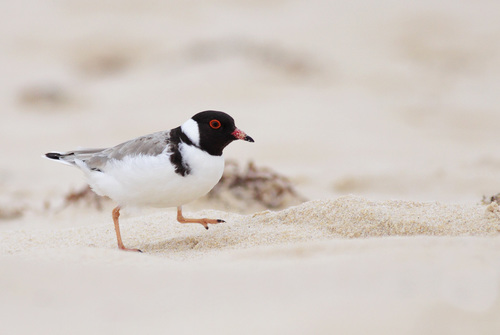
Hooded Plover
Thinornis cucullatus
Meet the Hooded Plover, a resilient beach-dweller known for its striking black-and-white plumage and its determined spirit. These vulnerable shorebirds are the 'guardians of the coast,' nesting directly on the sand along Australia's southern shores.
Quick Identification
Size
Length 19–23 cm (7.5–9 in); wingspan 43–47 cm (17–18.5 in); weight 80–110 g (2.8–3.9 oz)
Colors
Distinctive black hood and throat; white collar on the nape; pale grey-brown upperparts; white underparts; red eye-ring and orange bill with a black tip. Sexes are monomorphic (look the same).
Key Features
- Distinctive black 'hood' and throat contrast with a white nape
- Bright red fleshy ring surrounding the eye
- Short orange-red bill with a prominent black tip
- Stout, pinkish-grey legs adapted for running on sand
When You’ll See Them
Geographic range
Where Does the Hooded Plover Live?
This charming shorebird is native to the southern coastline of the Australian continent. Its core range extends from the central coast of New South Wales, around the Victorian and South Australian coastlines, to the southwestern corner of Western Australia. They are also widely distributed across the beaches of Tasmania, where some of the highest population densities of the species are found today.
Basemap © OpenStreetMap contributors
Behavior
Hooded Plovers are charismatic shorebirds known for their energetic, bobbing gait as they scurry across the sand. They are predominantly found in pairs or small family groups, maintaining strict territories on high-energy ocean beaches. Despite their bold markings, they can be surprisingly cryptic against the sandy backdrop when they remain still, a defense mechanism against avian predators.
These birds are particularly sensitive to human presence, especially during their breeding season from August to March. They nest in simple scrapes in the sand above the high-tide mark, making them extremely vulnerable to trampling and disturbance. When threatened, adults often lead predators away from the nest with a "broken-wing" display, pretending to be injured to lure threats toward themselves and away from their flightless chicks.
EverydayEarth exclusive
Camera Tips
Since Hooded Plovers nest on the ground, your AI camera should be positioned low—ideally 20-30 cm off the ground—to capture their eye-level perspective. Because they are a vulnerable species, it is crucial to set up cameras near known nesting sites only if you can do so without causing disturbance. Use a wide-angle lens if possible to capture the bird within its vast beach environment while maintaining a respectful distance.
Focus your camera on the high-tide line or "wrack" line where kelp and seaweed accumulate. This is where Hooded Plovers spend most of their time foraging for insects and tiny crustaceans. If you have a backyard that borders a beach or a salt lake, positioning the camera near a natural depression or a piece of driftwood can provide a focal point that the birds may use for shelter or as a lookout post.
These birds move very quickly across the sand. Use a fast shutter speed or high-frame-rate video setting (at least 60fps) to avoid motion blur. Since beach environments are very bright, ensure your camera has a good dynamic range or adjust the exposure compensation to -0.5 to prevent the white belly feathers from "blowing out" in the harsh midday sun.
Never use food bait to attract Hooded Plovers, as this can attract predators like gulls, ravens, or foxes to their sensitive nesting areas. Instead, rely on natural attractants like piles of beach-cast seaweed. Early morning and late afternoon provide the best lighting and are the times when the birds are most active and less likely to be hiding from human beach-goers or seeking shade.
Similar Species
Species that look similar or are commonly confused with Hooded Plover.
Frequently Asked Questions
Record Hooded Plover at your habitat
Connect a camera to start building your own species record — AI identifies every visitor automatically.