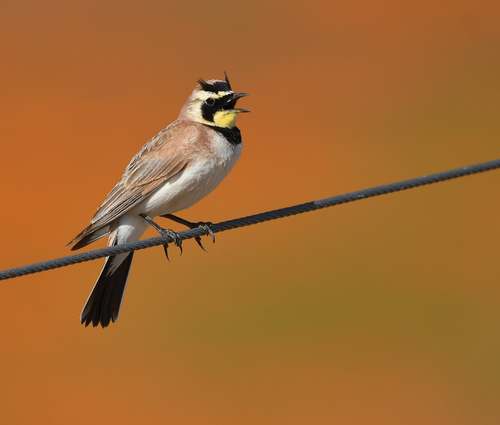
Horned Lark
Eremophila alpestris
The Horned Lark is the ultimate minimalist of the bird world, thriving in the vast, open spaces that others find barren. With its striking facial mask and tiny feather 'horns', it is a subtle beauty of the prairie and the shore.
Quick Identification
Size
Length: 16–20 cm (6.3–7.9 in); Wingspan: 30–34 cm (11.8–13.4 in); Weight: 28–48 g (1.0–1.7 oz)
Colors
Sandy-brown or grayish back; white or pale yellow face and throat; bold black 'mask', chest bib, and forehead stripe; males have small black feather 'horns'
Key Features
- Two small black feather tufts or 'horns' on the head
- Striking black facial mask and broad black chest crescent
- Ground-dwelling bird that walks or runs rather than hopping
- Dark tail with narrow white outer feathers
When You’ll See Them
Sightings on EverydayEarth
Jun 30, 2026
Under the glow of infrared light, an adult Osprey rests quietly in the nest, occasionally shifting its head and looking around. In the background, a Horned Lark is perched on a wooden post, staying alert and briefly preening its feathers.
May 28, 2026
A Horned Lark is perched on a stick-built nesting platform, turning its head to survey the surrounding wetlands. In the background, several Canada Geese are swimming in the river. The scene is illuminated by the morning sun, with light mist clinging to the water's surface.
May 15, 2026
A Horned Lark is perched on the wooden support beam of the nesting platform. It stays in one spot but is very active in surveying its surroundings, turning its head back and forth to scan the wetlands and mountains in the distance.
Geographic range
Where Does the Horned Lark Live?
Native across much of the Northern Hemisphere, the Horned Lark is a widespread traveler found throughout North America, Europe, and Asia. In the Americas, they range from the high Arctic tundra through the United States and Mexico, with a unique, isolated population living high in the Andes Mountains of Colombia. In the Old World, they are often known as Shore Larks, frequenting the northern coasts and the vast interior plains of Russia and China.
Basemap © OpenStreetMap contributors
Behavior
The Horned Lark is a true creature of the open ground, often seen walking or running across barren soil rather than hopping like many other songbirds. They are highly social outside of the breeding season, forming large nomadic flocks that roam agricultural fields and shorelines in search of food. During the spring, males perform spectacular aerial displays, spiraling high into the sky and singing a tinkling, high-pitched song before diving back toward the earth.
In many regions, they are among the earliest nesters, often starting their families while snow is still on the ground. To protect their eggs from the cold, they build nests in small hollows on the ground, often adding a 'pavement' of small flat stones or clods of dirt on one side of the nest. While they are generally wary of humans, they have adapted well to human-altered landscapes like airports and large-scale farms where wide-open spaces are maintained.
EverydayEarth exclusive
Camera Tips
To capture high-quality footage of a Horned Lark, you must get your camera down to ground level. These birds almost never perch on trees or high shrubs, so a camera mounted on a standard fence post will likely miss the action. Instead, mount your AI-powered camera on a low stake or even a heavy-duty tripod set just 6 to 12 inches off the ground. Aim the lens across a patch of bare earth or very short grass, as this is where they spend the majority of their time foraging.
If you are trying to attract them to a specific spot in your backyard or field, clear a small patch of vegetation to create a 'dust bath' area. Horned Larks love dry, loose soil for bathing. Providing a very shallow ground-level birdbath—basically a saucer with just an inch of water—can also be an effective lure, especially in arid environments. For bait, scattered cracked corn or mixed wild bird seeds on the bare ground (rather than in a hanging feeder) is the best way to keep them in the camera's field of view.
Lighting is crucial for ground-level shots. Position your camera facing north or south to avoid the harsh glare of the rising or setting sun, which can wash out the subtle tan and yellow tones of the bird's plumage. Set your camera's trigger sensitivity to high, as these birds move quickly and can be easily missed. If your camera allows for 'Burst Mode,' use it; capturing the moment the male raises his 'horns' requires multiple frames to get the timing just right.
Similar Species
Species that look similar or are commonly confused with Horned Lark.
Western Meadowlark
Much larger than a lark with a bright yellow breast and a thick, chunky bill.
American Pipit
Lacks the black facial mask and bib; has a thinner bill and bobs its tail constantly while walking.
Lapland Longspur
Often found in the same winter flocks, but lacks the yellow face and has a more rufous (reddish) nape.
Frequently Asked Questions
Record Horned Lark at your habitat
Connect a camera to start building your own species record — AI identifies every visitor automatically.