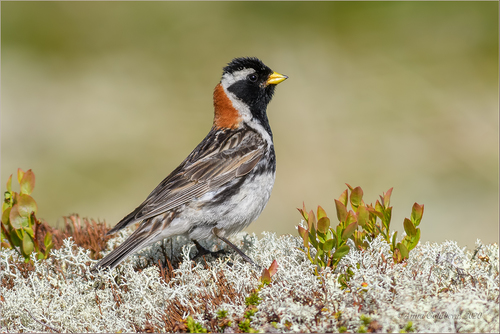
Lapland Longspur
Calcarius lapponicus
A champion of the high Arctic, the Lapland Longspur brings a touch of the tundra to winter fields across the globe. Known for its incredible endurance and striking chestnut nape, this ground-walking specialist is a prize for any backyard observer.
Quick Identification
Size
Length: 15–16 cm (5.9–6.3 in); Wingspan: 25–29 cm (9.8–11.4 in); Weight: 22–35 g (0.8–1.2 oz)
Colors
Breeding males feature a bold black face and throat, a creamy-white stripe behind the eye, and a distinctive chestnut nape. Females and non-breeding males are more camouflaged with sparrow-like brown streaking and a subtle rufous tint on the wings and nape.
Key Features
- Bright chestnut-red collar or nape
- Elongated hind claw (the 'longspur')
- White outer tail feathers conspicuous in flight
- Heavy, triangular yellowish bill with a dark tip
- Breeding males have a solid black mask and bib
When You’ll See Them
Geographic range
Where Does the Lapland Longspur Live?
The Lapland Longspur is a true circumpolar traveler, claiming the vast reaches of the Northern Hemisphere as its home. These hardy songbirds spend their summers in the high Arctic tundra across North America, Greenland, Northern Europe, and Russia. As the winter chill sets in, they migrate south to the temperate grasslands and agricultural heartlands of the central United States, southern Canada, Central Europe, and across the steppes of Asia. Because they rely on open ground, they are most frequently encountered in the 'breadbasket' regions of these continents where harvested fields provide ample forage.
Basemap © OpenStreetMap contributors
Behavior
Lapland Longspurs are highly gregarious birds, especially outside of the breeding season. During the winter, they form massive, swirling flocks that can number in the thousands, often mixing with Horned Larks and Snow Buntings. Unlike many small songbirds that hop, longspurs are dedicated walkers and runners. They spend the vast majority of their time on the ground, scurrying through short grass or stubble in search of food with a distinctive creeping gait.
On their Arctic breeding grounds, males perform a beautiful aerial display, spiraling upward and then parachuting down while singing a fluid, tinkling song. They are generally shy around humans in their wintering range, preferring wide-open agricultural fields or shorelines where they can spot predators from a distance. If startled, the entire flock will often take flight simultaneously in a tight, undulating cloud before settling back down a short distance away.
EverydayEarth exclusive
Camera Tips
To capture the Lapland Longspur on camera, you must think like a ground-dweller. These birds rarely, if ever, use elevated bird feeders, so your camera should be positioned just a few inches off the ground. Aim your lens at a flat, open patch of earth or very short grass. Since they are wary of vertical structures that might hide predators, avoid placing your camera near dense brush or tall fences. A wide, open line of sight will make the birds feel secure enough to linger in front of your lens.
Baiting is highly effective for this species during the winter months. Create a 'micro-habitat' by clearing a small patch of snow (if applicable) and scattering a mix of fine cracked corn, white proso millet, and hulled sunflower seeds. Avoid large pellets or whole corn, as their bills are better suited for smaller seeds. Spreading the seed in a wide, thin layer rather than a pile will encourage the birds to walk around, giving you better opportunities for various action shots and clear side-profile views.
Timing and lighting are critical for these birds. They are most active in the early morning as they replenish energy lost during cold nights. Position your camera facing north or south to avoid the harsh glare of the low winter sun, which can wash out the subtle brown and rufous tones of their plumage. Because they move quickly and constantly flick their tails or heads while foraging, use a fast shutter speed or a 'burst' photo mode if your camera supports it. If using a trail camera, set the trigger interval to the shortest possible time to capture the fluid motion of the flock.
Similar Species
Species that look similar or are commonly confused with Lapland Longspur.
Snow Bunting
Much more white in the plumage, especially on the wings, and lacks the chestnut nape of the Longspur.
Horned Lark
Features a distinct yellow and black face pattern and 'horns' of feathers, lacking the streaked brown back of the Longspur.
Smith's Longspur
Has a distinct buffy-orange underbelly and a more prominent white shoulder patch compared to the Lapland's white/grey belly.
Frequently Asked Questions
Record Lapland Longspur at your habitat
Connect a camera to start building your own species record — AI identifies every visitor automatically.