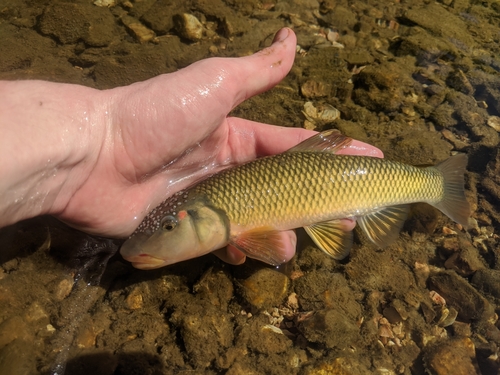
Hornyhead Chub
Nocomis biguttatus
A master mason of the underwater world, the Hornyhead Chub is famous for building massive stone nests that support entire communities of stream fish. With its distinctive 'horns' and bright red eye-spot, this hardy minnow is a cornerstone of healthy North American waterways.
Quick Identification
Size
Typically 6 to 9 inches (15–23 cm) in length, with exceptionally large males reaching up to 11 inches (28 cm). They usually weigh between 0.2 and 0.5 lbs (90–225 g).
Colors
Olive-brown to brassy on the back, transitioning to silvery-yellow sides and a white belly. Adult males feature a small, distinctive red spot behind the eye and develop light-colored, horn-like bumps on their heads during spawning.
Key Features
- Small red spot directly behind the eye in adult males
- Conical breeding tubercles (horns) on the head of males during spring
- Stocky, cylindrical body with an olive-brown back
- Terminal mouth with a tiny, often inconspicuous barbel at the corners
When You’ll See Them
Geographic range
Where Does the Hornyhead Chub Live?
The Hornyhead Chub is a quintessential resident of North American freshwater systems, primarily found in the temperate regions of the central United States and southern Canada. Its native territory spans from the upper Hudson River drainage in New York across the Great Lakes basin and into the Mississippi River system, reaching as far west as the tributaries of the Missouri River in Wyoming and the Dakotas. In Canada, this hardy minnow thrives in the southern portions of Ontario and Manitoba, particularly in clear-water streams that feed into the major lake systems. While they are widely distributed across this core range, their presence is a hallmark of high-quality, silt-free aquatic environments.
Basemap © OpenStreetMap contributors
Behavior
The Hornyhead Chub is a fascinating 'ecosystem engineer' of the stream bed. They are best known for their industrious nest-building behavior during the spring. Males painstakingly collect thousands of pebbles in their mouths, stacking them into large, underwater mounds that can reach up to two feet in diameter. These nests are so well-constructed that several other species of minnows, such as shiners and dace, congregate there to use the Chub's mound for their own egg-laying, creating a bustling underwater community center.
These fish are generally social and non-aggressive, except when a male is defending his nest site. They are active during daylight hours, spending most of their time near the bottom of the stream where they forage. Unlike some more sensitive species, the Hornyhead Chub can tolerate a range of temperatures, but they are highly sensitive to siltation and pollution; their presence is often used by biologists as a sign of a healthy, clear-water stream environment.
EverydayEarth exclusive
Camera Tips
Capturing the Hornyhead Chub requires an underwater camera setup, as these fish are rarely visible from the surface due to light refraction. If you have a clear backyard stream, look for 'stone mounds'—unusually clean piles of gravel that look out of place on the stream bed. These are the nests. Use a waterproof action camera (like a GoPro) or a trail camera in a dedicated underwater housing. Mount the camera on a weighted base or a heavy flat rock, positioning it 18 to 24 inches away from the nest mound, angled slightly upward to catch the fish against the light filtering through the water surface.
The best time to record is during the spring breeding season (May to June). This is when the males are most active, constantly moving stones and showing off their namesake 'horns' and vibrant red eye spots. To get the best clarity, aim for days with high sun and clear skies; mid-day (11 AM to 2 PM) provides the best natural light penetration into the water. If the water is moving quickly, ensure your camera mount is very secure to avoid 'camera shake' in your footage.
For camera settings, use the highest frame rate available (60fps or higher) because these fish can move with surprising speed when darting between rocks. While the nest itself is the best lure, if you are filming outside of the breeding season, you can attract them to a specific spot by placing a small mesh bag filled with crushed worms or salmon eggs tucked under a heavy rock directly in front of the lens. Avoid using loose bait, as the current will wash it away before the camera can trigger.
Similar Species
Species that look similar or are commonly confused with Hornyhead Chub.
Frequently Asked Questions
Record Hornyhead Chub at your habitat
Connect a camera to start building your own species record — AI identifies every visitor automatically.