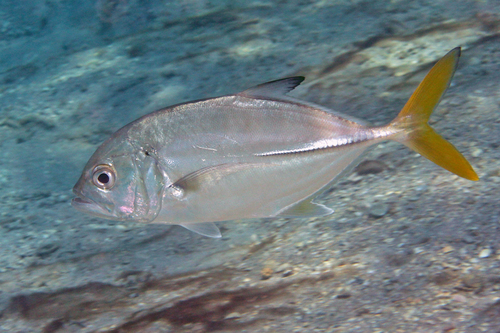
Horse-eye Jack
Caranx latus
A silver lightning bolt of the Atlantic, the Horse-eye Jack is a master of the hunt. Distinguished by its oversized eyes and brilliant yellow fins, this social predator brings high-octane energy to any coastal camera feed.
Quick Identification
Size
60 to 101 cm (24 to 40 inches) in length; typically weighs 2 to 7 kg (4 to 15 lbs), though record sizes exceed 13 kg (29 lbs).
Colors
Brilliant silver body with a dark blue-green to grayish-back; fins are generally yellow, particularly the deeply forked tail fin.
Key Features
- Disproportionately large eyes with a visible adipose eyelid
- Deep, compressed body shape with a less-blunt forehead than the Crevalle Jack
- A series of dark, hardened scales called scutes along the base of the tail
- Small black spot on the operculum (gill cover).
When You’ll See Them
Geographic range
Where Does the Horse-eye Jack Live?
The Horse-eye Jack is a wide-ranging inhabitant of the Atlantic Ocean, thriving in both the western and eastern tropical corridors. In the Americas, its range begins as far north as New Jersey and extends through the Gulf of Mexico and the Caribbean Sea, following the coastline all the way down to Rio de Janeiro, Brazil. Across the sea, it is commonly found along the western coast of Africa, spanning the waters from Senegal down to the southern borders of Angola. This species is a true ocean wanderer, making it a common sight across almost all tropical and subtropical Atlantic archipelagos.
Basemap © OpenStreetMap contributors
Behavior
Horse-eye Jacks are high-energy, schooling predators that represent the dynamic spirit of the Atlantic reefs. They are most frequently seen in mid-water groups, ranging from small clusters to massive schools that move with coordinated precision. These fish are remarkably curious and are known to approach divers and underwater camera installations, often circling the equipment to investigate before moving on. Unlike more sedentary reef fish, the Horse-eye Jack is a constant traveler, patrolling the edges of reefs and drop-offs in search of food.
Their social structure is built around group hunting. When a school locates a concentration of baitfish, they work together to drive the prey toward the surface or against a reef face, creating a frantic feeding event known as a 'boil.' While they are primarily marine, they are highly adaptable and are frequently documented entering brackish estuaries and even swimming up coastal rivers to find food or shelter from larger predators.
EverydayEarth exclusive
Camera Tips
For those lucky enough to have a backyard dock or sea wall in coastal regions, capturing Horse-eye Jacks on camera requires understanding their love for structure. Mount your underwater camera 3 to 5 feet below the low-tide line, preferably facing a pillar or a reef edge where current is present. These fish are 'ram ventilators,' meaning they need to keep moving to breathe efficiently, so they are almost always found where the water is flowing or crashing against a structure.
To get the best clarity, aim your camera away from the sun to reduce glare on the silver scales of the fish. If your camera setup supports it, use a wide-angle lens; because Horse-eye Jacks travel in schools, a narrow field of view will often only capture a blur of silver rather than the magnificent group movement. Dawn and dusk are the 'power hours' for this species; the low light reflects beautifully off their metallic sides, and their activity levels peak as they hunt for breakfast or dinner.
While baiting is common in some wildlife photography, Horse-eye Jacks are naturally inquisitive. A clean, shiny camera lens or a small piece of reflective metal hung nearby can often entice a school to come in close for a 'selfie.' If you do use a lure, a mesh bag filled with oily fish like sardines or mackerel will create a scent trail that these jacks find irresistible. Ensure your camera is set to a high frame rate (at least 60fps) to keep up with their rapid, darting movements.
Similar Species
Species that look similar or are commonly confused with Horse-eye Jack.
Frequently Asked Questions
Record Horse-eye Jack at your habitat
Connect a camera to start building your own species record — AI identifies every visitor automatically.