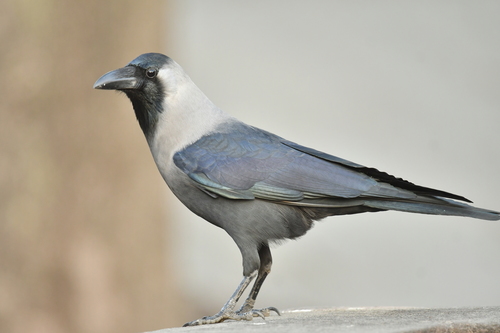
House Crow
Corvus splendens
Meet the House Crow, the clever 'grey-necked' urbanite of the bird world. Renowned for its sharp wit and social nature, this adaptable corvid is a master of living alongside humans in the world's busiest cities.
Quick Identification
Size
Length of 40–43 cm (15.7–16.9 in); wingspan of 76–85 cm (30–33.5 in); weight between 250–350 g (8.8–12.3 oz)
Colors
Glossy black forehead, crown, and throat; distinctive lighter grey-brown neck and upper breast; black wings, tail, and legs
Key Features
- Distinctive grey-brown collar contrasting with black face
- Slimmer, more elongated build than most crows
- Strong, slightly curved black bill
- Highly vocal with a flat, harsh 'kaaa-kaaa' call
When You’ll See Them
Geographic range
Where Does the House Crow Live?
The House Crow is native to the Indian Subcontinent, with its core populations spanning across India, Pakistan, Sri Lanka, Bangladesh, and Myanmar. Because of its habit of hitchhiking on cargo ships, it has successfully established invasive populations in coastal regions of East Africa, the Middle East, and parts of Europe like the Netherlands. In these new territories, it remains a strictly lowland bird, rarely venturing far from the human-dominated landscapes where it first arrived.
Basemap © OpenStreetMap contributors
Behavior
The House Crow is one of the most socially complex and intelligent birds you will encounter in a suburban environment. They are highly gregarious, often gathering in large, noisy communal roosts that can number in the thousands. Known for their extreme boldness, they have evolved to live in close proximity to humans, often observing our patterns to identify easy food sources. Their intelligence is evident in their problem-solving abilities and their capacity to recognize individual human faces, often distinguishing between people who provide food and those who pose a threat.
In their daily lives, House Crows exhibit a high degree of cooperation, using various alarm calls to alert the flock to predators. They are opportunistic scavengers and will work together to distract larger animals or even pets to steal food. While they can be aggressive toward other bird species, their social interactions within their own groups are intricate, involving mutual preening and complex vocalizations that maintain flock hierarchy.
EverydayEarth exclusive
Camera Tips
Capturing the House Crow on camera requires a bit of stealth, as these birds are famously 'neophobic'—they are naturally suspicious of new objects in their environment. When setting up a backyard camera, it is best to place it in a discreet location or camouflage it with nearby foliage. Allow the camera to sit in place for 2–3 days without turning it on so the crows can acclimate to its presence. Position the lens at a slight downward angle toward a known feeding spot or a flat-topped fence where they like to perch and survey the area.
To lure House Crows into frame, high-protein treats like unsalted peanuts, suet, or even small bits of leftover cooked meat work exceptionally well. They are also highly attracted to water; a sturdy birdbath placed in a sunny spot will often draw them in for dramatic splashing shots. Because they are fast-moving and social, set your camera to 'Burst Mode' or a high frame rate for video. This ensures you catch the subtle social interactions, such as food-sharing or the ruffling of their grey neck feathers during a call.
Timing is everything with this species. They are most active in the early morning hours just after sunrise and again in the late afternoon before they head to communal roosts. During the summer months, keep your camera near shade or water sources, as they will frequently visit to cool off. Use a wide-angle lens if you want to capture the whole flock, as House Crows rarely travel alone and you’ll likely get better footage of their complex group dynamics if you aren't zoomed in too tight.
Similar Species
Species that look similar or are commonly confused with House Crow.
Frequently Asked Questions
Record House Crow at your habitat
Connect a camera to start building your own species record — AI identifies every visitor automatically.