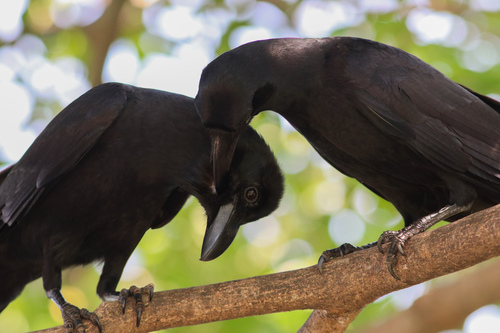
Large-billed Crow
Corvus macrorhynchos
The Large-billed Crow is the undisputed genius of the backyard. With a massive beak and a brain to match, this adaptable corvid turns every city street and forest edge into its own personal playground.
Quick Identification
Size
Length 46–59 cm (18–23 in); wingspan 100–130 cm (39–51 in); weight 450–1,000 g (1.0–2.2 lbs)
Colors
Entirely black plumage with a glossy sheen that can reflect blue, green, or purple in bright light. The bill, legs, and feet are also charcoal black.
Key Features
- Massive, deeply arched black bill with a curved upper ridge
- High, steep forehead profile creating a 'domed' look
- Shaggy throat feathers that puff out when calling
- Rounded tail visible during flight
When You’ll See Them
Geographic range
Where Does the Large-billed Crow Live?
Native to the Asian continent, the Large-billed Crow thrives across a vast territory stretching from the Russian Far East and the Japanese archipelago down through China and into the tropical reaches of Southeast Asia. While they are core residents of countries like Thailand and Vietnam, their extreme adaptability has allowed them to colonize numerous islands throughout the Malay Archipelago and the Philippines. Because they are so comfortable living alongside humans, you will find them in almost every major Asian city, though they remain equally at home in high-altitude mountain forests or along rugged coastlines.
Basemap © OpenStreetMap contributors
Behavior
The Large-billed Crow is a highly intelligent and opportunistic bird, often viewed as the 'urban mastermind' of the Asian avian world. They are deeply social and typically found in pairs or family groups, though they may gather in massive communal roosts at night. Their problem-solving abilities are legendary; they have been observed using tools and even timing their foraging to coincide with human schedules or traffic patterns to crack open hard nuts.
In human-dominated landscapes, they exhibit a bold and sometimes aggressive temperament, frequently raiding garbage bins or stealing food from outdoor markets. Despite their reputation as a nuisance in cities, they play a vital role as scavengers. Their vocalizations are remarkably diverse, ranging from deep, resonant 'caaa' calls to various clicks, rattles, and mimicry of other birds or environmental sounds.
EverydayEarth exclusive
Camera Tips
To capture high-quality footage of the Large-billed Crow, placement is everything. Since they spend significant time foraging on the ground but retreat to high perches when threatened, aim your camera at a height of 3 to 5 feet, angled slightly downward toward a clearing. If you have a flat-roofed shed or a sturdy fence line, these are ideal mounting spots as crows feel safer landing on elevated, flat surfaces before descending to the ground.
Baiting is highly effective but requires care. These crows are attracted to high-protein snacks like unsalted peanuts, suet, or even leftover cooked meat. To capture their famous intelligence on camera, try a 'puzzle feeder'—place food inside a cardboard box or a shallow container that requires them to manipulate an object to get the reward. This often results in fascinating behavioral footage of them using their massive bills as tools.
Be aware of their extreme 'neophobia'—a fear of new things. A Large-billed Crow will likely notice a new camera immediately and may avoid the area for several days. Use camouflage skins or hide the camera among foliage to reduce its profile. Once one brave individual decides the camera isn't a threat, the rest of the family group will usually follow, providing you with plenty of social interaction footage.
For the best visual results, set your camera to a fast trigger speed and high-frame-rate video. Their black feathers can be difficult for some sensors to expose correctly; if possible, position the camera so the sun is behind you, illuminating the bird directly. This helps the AI-powered sensor pick up the subtle iridescent sheen of their plumage rather than seeing them as a flat black silhouette.
Similar Species
Species that look similar or are commonly confused with Large-billed Crow.
Frequently Asked Questions
Record Large-billed Crow at your habitat
Connect a camera to start building your own species record — AI identifies every visitor automatically.