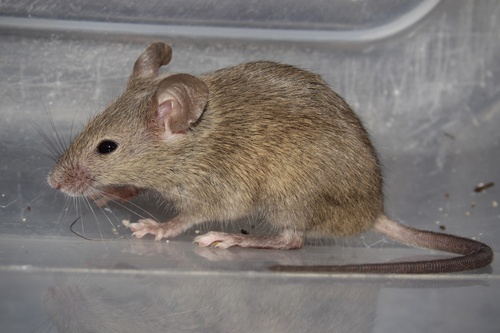
House Mouse
Mus musculus
Small, clever, and incredibly resilient, the House Mouse is one of the world's most successful mammals. While often seen as a simple pest, these agile rodents lead complex social lives and are masters of navigating the human world.
Quick Identification
Size
7.5–10 cm (3–4 in) head and body; 5–10 cm (2–4 in) tail; 12–30 g (0.4–1.1 oz)
Colors
Uniformly dusty gray to light brown upperparts; slightly lighter cream or gray belly; hairless pinkish-gray tail
Key Features
- Pointed snout with prominent whiskers
- Large, rounded ears with sparse hair
- Long, scaly, nearly hairless tail equal to head-and-body length
- Small, black, bead-like eyes
When You’ll See Them
Geographic range
Where Does the House Mouse Live?
Originally native to the grasslands of Central and Southern Asia, the House Mouse has successfully colonised every continent except Antarctica. This incredible expansion was driven by their close association with human travel and trade, allowing them to establish robust populations in virtually every country on Earth. Today, they are most concentrated in temperate and tropical regions where human infrastructure provides consistent shelter and food, from the dense urban centers of the United States and Europe to the rural landscapes of Australia and Africa.
Basemap © OpenStreetMap contributors
Behavior
House Mice are highly social and adaptable creatures that have mastered the art of living alongside humans. They are primarily nocturnal, using their keen sense of smell and long whiskers to navigate in the dark while staying close to walls and vertical surfaces. Within their territory, they establish complex social hierarchies led by a dominant male, often building shared nests where several females may raise their young together.
These rodents are incredibly agile; they are excellent climbers, capable of scaling vertical walls with enough texture, and can jump up to 12 inches high. Their curiosity is tempered by a natural caution called neophobia, though they are generally more willing to investigate new objects in their environment than larger rats. In human environments, they are opportunistic scavengers, memorizing the locations of food sources and pathways to safety.
EverydayEarth exclusive
Camera Tips
Capturing high-quality footage of a House Mouse requires a strategic approach due to their small size and rapid movements. Because these rodents prefer to travel along 'highways'—the edges where a wall meets the floor or a fence meets the ground—you should place your camera at ground level, parallel to a structure. Positioning the lens just 2 to 5 inches off the ground will provide an intimate, eye-level perspective of their behavior rather than a top-down view that often loses detail.
Since House Mice are tiny, the 'trigger zone' of a standard trail camera might be too high. Angle your camera slightly downward and ensure the focus distance is appropriate; many cameras struggle with objects closer than 3 feet. To get crisp shots, look for cameras with a 'macro' mode or a fast trigger speed (0.2s or less) to avoid capturing nothing but a blurry tail. If your camera settings allow it, use the 'Photo + Video' mode to capture a high-resolution still followed by a 10-15 second clip of their movement.
Baiting is highly effective for keeping a House Mouse in the frame long enough for a clear shot. A small smear of peanut butter on a rock or log in front of the camera is the gold standard, as they must linger to lick it off rather than grabbing a seed and running away. Because they are strictly nocturnal in most backyard settings, ensure your infrared (IR) flash is functioning well. To avoid 'white-out' (where the flash overexposes the subject at close range), you can place a piece of semi-transparent tape over part of the IR LED to diffuse the light.
Similar Species
Species that look similar or are commonly confused with House Mouse.
Frequently Asked Questions
Record House Mouse at your habitat
Connect a camera to start building your own species record — AI identifies every visitor automatically.