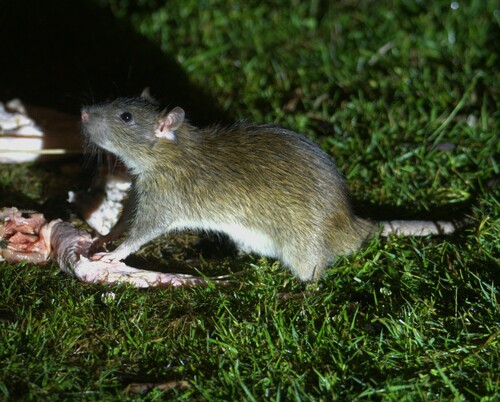
Brown Rat
Rattus norvegicus
Master of adaptation and urban survival, the Brown Rat is a fascinating neighbor often hidden just out of sight. From complex burrowing systems to high-intelligence social lives, these rodents offer a unique window into the wildlife that lives right alongside us.
Quick Identification
Size
Body length: 20–28 cm (8–11 in); Tail: 15–23 cm (6–9 in); Weight: 140–500 g (5–18 oz)
Colors
Coarse brown or greyish-brown fur on the back, transitioning to a lighter grey or pale yellow on the belly; tail is dark on top and lighter underneath.
Key Features
- Stocky body with a blunt snout
- Small, hair-covered ears
- Thick, scaly tail that is shorter than the combined head and body length
- Dark, bead-like eyes and prominent whiskers
When You’ll See Them
Geographic range
Where Does the Brown Rat Live?
Originally native to the temperate regions of Northern China and Mongolia, the Brown Rat has become one of the most successful invasive species in history by hitching rides on human trade ships. Today, they are found on every continent except Antarctica, thriving wherever human populations provide a steady supply of food and shelter. In North America and Europe, they are the dominant rat species, having successfully naturalized in virtually every city, town, and agricultural region across the globe.
Basemap © OpenStreetMap contributors
Behavior
Brown Rats are highly intelligent, social creatures that typically live in hierarchical colonies. They are primarily nocturnal, spending their nights foraging for food and exploring their environment. Known for their remarkable adaptability, they have developed a keen sense of "neophobia"—a cautious suspicion of new objects in their environment—which helps them avoid traps and predators in urban settings.
These rodents are exceptional diggers and often create complex burrow systems with multiple entrances and exit holes. Despite their reputation, they are meticulous groomers and maintain a high level of social interaction within their groups, communicating through ultrasonic vocalizations and scent marking. In human-dominated landscapes, they exhibit commensal behavior, expertly navigating sewers, basements, and garden structures to find resources.
EverydayEarth exclusive
Camera Tips
To capture Brown Rats on camera, placement is everything. These rodents are creatures of habit and usually travel along "rat runs"—established paths that follow vertical edges like garden walls, fences, or the foundations of houses. Position your camera about 2 to 4 inches off the ground, angled parallel to a wall or fence line rather than pointing directly at it. This increases the chances of capturing the animal in profile as it scampers by.
Because rats are naturally suspicious of new objects (neophobia), it may take several days for them to become comfortable with your camera. Avoid moving the camera frequently. For the best results, use a "No-Glow" or black-LED infrared flash. Brown Rats have excellent night vision and can sometimes be spooked by the faint red glow of standard IR cameras, which might cause them to avoid the area in the future.
High-scent lures are incredibly effective for drawing them into the frame. A small smear of peanut butter or a handful of birdseed placed about 3 to 5 feet from the lens works wonders. Try to place the bait near a small piece of cover, like a log or a brick; rats feel safer eating when they aren't in the wide open. Set your camera to a high-sensitivity trigger and use "Burst Mode" or short 10-second video clips, as these animals move very quickly and can be gone in a flash.
Similar Species
Species that look similar or are commonly confused with Brown Rat.
Black Rat
Smaller and more slender with ears that can be pulled over the eyes and a tail longer than the body.
House Mouse
Significantly smaller (about 1/10th the weight) with much larger ears relative to its head size.
Muskrat
Much larger and semi-aquatic with a vertically flattened tail used for swimming.
Frequently Asked Questions
Record Brown Rat at your habitat
Connect a camera to start building your own species record — AI identifies every visitor automatically.