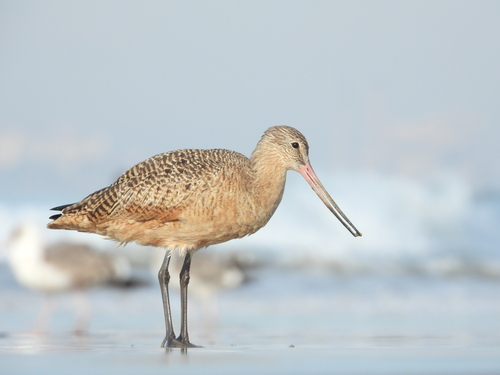
Marbled Godwit
Limosa fedoa
The Marbled Godwit is a master of the mudflats, using its long, slightly upturned bill to probe for hidden treasures. With its warm cinnamon plumage and impressive migratory journey, it is a crown jewel of the North American shoreline.
Quick Identification
Size
Length: 42-48 cm (17-19 in), Wingspan: 74-82 cm (29-32 in), Weight: 285-454 g (10-16 oz)
Colors
Overall cinnamon-buff with dark brown mottling on the back; wings show bright cinnamon under-linings in flight; bill is pinkish at the base with a black tip.
Key Features
- Long, bi-colored bill with a slight upward curve
- Beautifully mottled cinnamon and brown 'marbled' plumage
- Distinctive bluish-gray legs
- Largest of the four godwit species
When You’ll See Them
Geographic range
Where Does the Marbled Godwit Live?
Native to North America, the Marbled Godwit follows a distinct migratory path between the interior plains and the ocean. Its primary breeding grounds are located in the northern Great Plains of the United States and Canada, specifically throughout the prairie pothole region. Once winter approaches, these birds migrate to the Pacific, Atlantic, and Gulf coasts, where they can be found from the southern United States down through Mexico and into Central America. Because they rely on very specific wetland habitats, they are most commonly spotted in high-density pockets along coastlines rather than being evenly distributed across the continent.
Basemap © OpenStreetMap contributors
Behavior
During the breeding season on the northern prairies, their behavior shifts from social to territorial. Males perform dramatic, loud aerial displays to defend nesting sites, flying in wide circles while calling out a rhythmic 'rad-ka-rad-ka.' While they are generally wary of humans in the wild, they can become quite habituated to people in coastal areas with high foot traffic, often foraging just a few yards away from beachgoers.
EverydayEarth exclusive
Camera Tips
Capturing a Marbled Godwit on a trail camera requires an understanding of tidal patterns. If you are placing a camera near a coastal area or estuary, position it at the 'wrack line'—the debris line left by the high tide. As the tide comes in, it pushes the godwits closer to the shore, funneling them right in front of your lens. Set your camera on a very low tripod or a flat ground mount to get an eye-level perspective; this creates a professional-looking 'bokeh' background and emphasizes the bird's impressive bill.
Because shorebirds move quickly while probing, use a camera with a fast trigger speed (0.2 seconds or less) and set it to a multi-shot burst mode. This ensures you capture the moment the bird pulls a worm or crab from the substrate. If your camera allows for video, 60fps is ideal for slowing down their rapid 'stitching' feeding motion in post-production. Make sure your housing is well-sealed against salt spray, which is corrosive; a simple protective 'rain hood' can save your equipment in coastal environments.
Lighting is your best friend when trying to highlight their cinnamon-colored plumage. Aim for western-facing placements for morning shots or eastern-facing for evening golden hour. Avoid mid-day sun, as the reflection off the wet mud can cause harsh highlights and 'blow out' the details in the bird's feathers. If setting up in a backyard that borders a wetland, ensure there is an open patch of mud or very shallow water, as Marbled Godwits avoid dense vegetation where predators might hide.
Similar Species
Species that look similar or are commonly confused with Marbled Godwit.
Long-billed Curlew
The Curlew is larger and has a much longer bill that curves significantly downward, whereas the Godwit's bill curves slightly upward.
Hudsonian Godwit
The Hudsonian is smaller, has a darker chest during breeding, and shows a distinct black-and-white tail pattern in flight.
American Avocet
Avocets have a much more dramatic upward curve to their thinner bills and feature bold black and white wing patterns.
Frequently Asked Questions
Record Marbled Godwit at your habitat
Connect a camera to start building your own species record — AI identifies every visitor automatically.