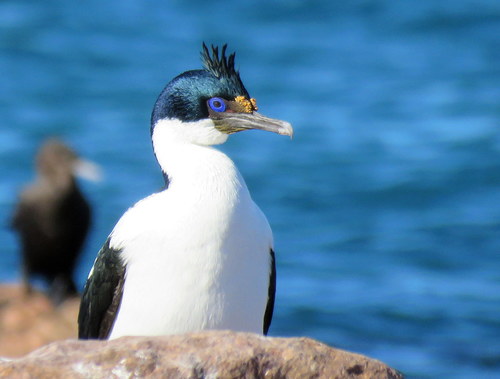
Imperial Shag
Leucocarbo atriceps
With its striking blue eye-rings and elegant black-and-white plumage, the Imperial Shag is a master of the Southern Ocean's frigid depths. Whether nesting on wind-battered cliffs or diving for fish in Patagonian fjords, this charismatic seabird is a true icon of the subantarctic wild.
Quick Identification
Size
Length: 70–79 cm (28–31 in); Wingspan: 124 cm (49 in); Weight: 1.8–3.5 kg (4–7.7 lbs)
Colors
Glossy black upperparts (head, neck, back, wings) and stark white underparts. Features a vivid blue ring of skin around the eyes and orange-yellow caruncles at the base of the bill.
Key Features
- Vivid blue ring of skin around the eyes
- Yellow-orange fleshy caruncles at the base of the bill
- Glossy black upperparts with stark white throat and belly
- Prominent black crest during the breeding season
- Pinkish-gray webbed feet
When You’ll See Them
Sightings on EverydayEarth
Apr 25, 2026
A dense colony of Imperial Shags is active on a rocky coastline. Many birds are seen sitting on raised, mound-like nests made of mud and guano, while others stand or move through the crowd. There is significant movement as individuals adjust their positions, preen, and stretch their necks in social interactions.
Apr 21, 2026
A bustling scene at the coast where a large colony of Imperial Shags stands across the rocky terrain. Several Magellanic Penguins are interspersed within the group, waddling between the shags. In the background, South American Sea Lions are hauled out on the wet rocks as waves crash against the shore under a pale morning sky.
Apr 20, 2026
A large and active colony of Imperial Shags is gathered on a rocky, kelp-covered shoreline. The birds are seen moving about, with many walking together in a synchronized fashion while others stand alert or groom themselves. Waves crash steadily against the shore in the background.
Apr 20, 2026
A large colony of Imperial Shags is active on a sandy beach covered in washed-up kelp. The birds are seen walking, turning their heads, and standing in groups near the shoreline as waves crash in the background. One bird is captured flying across the frame from left to right.
Apr 18, 2026
A dense colony of Imperial Shags is active on a rocky, guano-covered nesting site. Numerous birds are seen standing on or tending to raised, mound-like nests. Several individuals in the foreground and throughout the colony are preening their feathers, stretching their necks, and occasionally interacting with their neighbors as the group maintains its social structure.
Apr 18, 2026
A group of Imperial Shags is gathered on the rocky shoreline. Several birds are walking across the uneven terrain while others stand near the water's edge as waves crash against the rocks. One individual briefly stretches its wings before continuing to move across the colony.
Geographic range
Where Does the Imperial Shag Live?
Native to the southernmost reaches of the Southern Hemisphere, the Imperial Shag thrives along the rugged coastlines of southern South America, specifically in Chile and Argentina. Its range extends across the cold waters of the Southern Ocean to the Antarctic Peninsula and various subantarctic island chains like the Falklands and South Georgia. These birds are iconic residents of the windswept Patagonian fjords and the icy fringes of the Antarctic continent.
Basemap © OpenStreetMap contributors
Recorded on EverydayEarth
Behavior
Imperial Shags are highly social and gregarious birds, often found in massive, noisy colonies that can number in the thousands. They are exceptional divers, utilizing their powerful webbed feet to propel themselves to incredible depths—sometimes reaching nearly 100 meters—in search of prey. Unlike many other seabirds, they are known to forage both individually and in synchronized groups called "rafts," where they work together to herd schools of fish toward the surface.
While they spend much of their time at sea, they are common sights along coastal settlements, often resting on man-made structures like piers, jetties, and harbor walls. Their social life is centered around the breeding colony, where they engage in elaborate ritualized displays, such as "head-shaking" and "sky-pointing," to strengthen pair bonds. They are generally tolerant of humans but will aggressively defend their small nesting territories from encroaching neighbors or scavengers.
EverydayEarth exclusive
Camera Tips
To capture the Imperial Shag on camera, focus on rocky outcrops or piers near the shoreline where they typically dry their wings. Because their feathers are not fully waterproof, they spend significant time perched with their wings spread wide to catch the wind. Positioning your camera at a low angle (about 1-2 feet off the ground) can create a dramatic perspective that highlights their striking blue eye-rings and yellow caruncles against the ocean backdrop.
Since these birds inhabit harsh, windy environments, ensure your camera housing is extremely weather-resistant and securely anchored to rocks or heavy driftwood. Avoid placing cameras in the direct splash zone to prevent salt spray from blurring the lens. If you are near a breeding colony, set your camera at a distance of at least 15-20 feet to avoid disturbing the birds; use a high-resolution sensor or a zoom-capable trail camera to get the best detail without causing stress.
The best time for activity is during the 'golden hours' of early morning or late afternoon when they return from foraging trips. Fast shutter speeds are essential (1/1000s or faster) if you hope to catch them in flight or as they explode out of the water. While they don't respond to traditional birdseed, placing a camera near a known 'drying rock' or a popular jetty is far more effective than any artificial lure.
Similar Species
Species that look similar or are commonly confused with Imperial Shag.
Frequently Asked Questions
Record Imperial Shag at your habitat
Connect a camera to start building your own species record — AI identifies every visitor automatically.