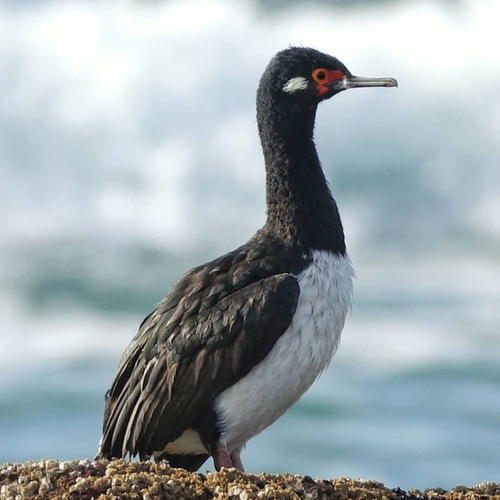
Magellanic Cormorant
Leucocarbo magellanicus
A master of the southern kelp forests, the Magellanic Cormorant is a striking seabird defined by its vibrant red facial skin and incredible diving prowess. Thriving where the Andes meet the ocean, this resilient species is a true icon of the Patagonian coast.
Quick Identification
Size
Length: 66–71 cm (26–28 in); Wingspan: approx 100 cm (39 in); Weight: 1.4–1.6 kg (3.1–3.5 lbs)
Colors
Glossy black upperparts and neck with a stark white belly; breeding adults feature bright red facial skin and a small white patch behind the eye.
Key Features
- Bright red skin around the eyes
- White belly and lower breast contrasting with a black neck
- White ear-covert patch present during breeding season
- Small, slender black bill
When You’ll See Them
Geographic range
Where Does the Magellanic Cormorant Live?
The Magellanic Cormorant is native to the southern extremities of South America, with a core range that encompasses the rugged coastlines of southern Chile and Argentina down to Cape Horn. They are a staple of the Falkland Islands' birdlife and are commonly found from Valdivia on the Pacific side to Punta Tombo on the Atlantic. While many remain near their breeding grounds year-round, northern movements occur during winter, with some birds reaching as far as central Chile and Uruguay.
Basemap © OpenStreetMap contributors
Behavior
On land, they are gregarious but selective, preferring to roost and nest on the narrowest ledges of steep, inaccessible sea cliffs. This behavior offers protection from land-based predators. When not fishing, they spend a significant amount of time perched on rocks with their wings spread wide to dry, a necessary ritual because their feathers are not entirely waterproof, which helps them reduce buoyancy for deeper diving.
EverydayEarth exclusive
Camera Tips
Lighting is your biggest challenge near the ocean. Use a camera with a high dynamic range or adjustable exposure settings to prevent the bright white of the bird's belly from blowing out against its dark back in the midday sun. Setting your camera to a burst mode of 3-5 photos per trigger is ideal for capturing the moment they shake their wings or transition from the water to the rock.
If you are monitoring a cliffside area, ensure the camera is securely tethered to prevent it from being lost in high winds or falling into the sea. Since these birds do not respond to traditional baits, timing is everything; early morning and late afternoon provide the best natural light and coincide with their most frequent transitions between the ocean and their roosts. Avoid placing cameras during the height of the breeding season in sensitive nesting areas to prevent disturbing the colony.
Similar Species
Species that look similar or are commonly confused with Magellanic Cormorant.
Imperial Shag
Larger with a white neck and blue eye-rings, unlike the black neck and red eye-rings of the Magellanic.
Red-legged Cormorant
Distinctive bright orange-red legs and a greyish body, rather than the black-and-white tuxedo look of the Magellanic.
Neotropic Cormorant
Much thinner, entirely black plumage even on the belly, and lacks the bright red facial skin.
Frequently Asked Questions
Record Magellanic Cormorant at your habitat
Connect a camera to start building your own species record — AI identifies every visitor automatically.