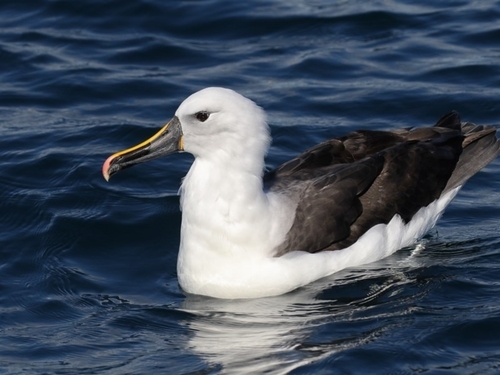
Indian Yellow-nosed Albatross
Thalassarche carteri
A graceful nomad of the southern seas, the Indian Yellow-nosed Albatross is easily recognized by the brilliant golden streak atop its bill. This endangered mariner spends its life riding the wind, returning to land only to raise its young on remote, rocky islands.
Quick Identification
Size
Length: 75–80 cm (30–31 in); Wingspan: 2 m (6.6 ft); Weight: 1.8–2.9 kg (4.0–6.4 lb)
Colors
White body and head with a pale grey wash on the face; dark slate-grey upperwings and tail. The bill is black with a signature bright yellow ridge (culminicorn) and a reddish tip.
Key Features
- Bright yellow stripe along the top of the black bill
- Reddish-orange tip on the bill
- Pale grey wash on the head and nape
- Pure white underwings with thin black margins
- Smallest of the mollymawk albatrosses
When You’ll See Them
Geographic range
Where Does the Indian Yellow-nosed Albatross Live?
The Indian Yellow-nosed Albatross is a native of the Southern Indian Ocean, breeding on a tiny handful of remote outposts including the Prince Edward Islands, Crozet Islands, Kerguelen Islands, Amsterdam Island, and St. Paul Island. When not nesting, these birds range widely across the southern seas, frequently appearing in the coastal waters of Southern Australia, South Africa, and New Zealand. They are high-seas specialists, rarely seen from land except from prominent coastal headlands during periods of strong onshore winds.
Basemap © OpenStreetMap contributors
Behavior
The Indian Yellow-nosed Albatross is a master of the open ocean, spending most of its life utilizing dynamic soaring to glide over waves with minimal energy expenditure. While they are often solitary when traveling across the vast Southern Ocean, they are opportunistic scavengers and frequently congregate in large numbers behind fishing vessels to feed on offal and discarded catch.
During the breeding season, which begins in late winter (August), these birds transform from silent ocean wanderers into social colony members. They return to the same remote islands annually to reunite with their long-term mates. Their courtship is a beautiful display of ritualized movements, including bill-clapping, sky-pointing, and soft grooming, which helps maintain the pair bond for their single annual chick.
EverydayEarth exclusive
Camera Tips
Capturing an Indian Yellow-nosed Albatross on a trail camera requires a coastal setup with a clear, unobstructed view of the ocean. For those living on high bluffs or headlands in Southern Australia or South Africa, mount your camera on a stable post or tripod facing the prevailing winds. Albatrosses often 'hang' in the updrafts created by coastal cliffs, providing rare opportunities for close-up shots as they glide past at eye level.
Use a camera with a very fast trigger speed and high-speed burst mode. These birds move quickly, often exceeding 50 mph when banking into the wind. A shutter speed of 1/2000s or faster is essential to freeze the motion of their wings. If your camera allows for zone focusing, set it to the distance where birds typically pass the cliff edge to ensure they are crisp and clear when the sensor trips.
While baiting is not recommended for protected seabirds, natural 'lures' like kelp beds or areas where local fishing boats return to port can be excellent focal points. The birds are most active in the early morning and late afternoon when the light is angled; this 'golden hour' light is perfect for highlighting the yellow stripe on their bill, which is their most defining characteristic.
Consider the weather when placing your gear. The best sightings often occur during or immediately after a storm when 'pelagic' species are pushed closer to the shore. Ensure your camera housing is salt-spray resistant, as the coastal environment is highly corrosive. Periodically cleaning the lens with a microfiber cloth and fresh water will prevent salt crust from ruining your images.
Similar Species
Species that look similar or are commonly confused with Indian Yellow-nosed Albatross.
Atlantic Yellow-nosed Albatross
Features a darker grey head and neck compared to the whiter appearance of the Indian species.
Shy Albatross
Larger in size with a pale grey-green bill that lacks the bright yellow ridge.
Black-browed Albatross
Has a distinctive dark 'eyebrow' mark and an orange-yellow bill without the black base.
Frequently Asked Questions
Record Indian Yellow-nosed Albatross at your habitat
Connect a camera to start building your own species record — AI identifies every visitor automatically.