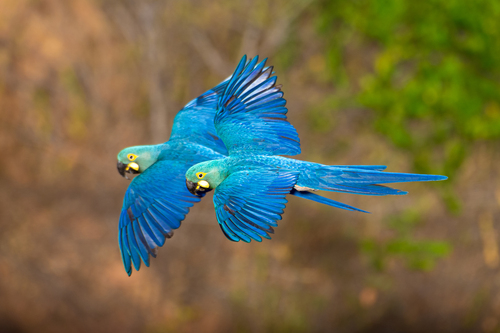
Indigo Macaw
Anodorhynchus leari
A cobalt-blue treasure of the Brazilian wilderness, the Indigo Macaw is one of the world's rarest and most specialized parrots. Living among the dramatic red sandstone cliffs of Bahia, these intelligent birds are a testament to the beauty of the Caatinga ecosystem.
Quick Identification
Size
Length 70–75 cm (27–30 in); Weight approximately 950 g (2.1 lbs)
Colors
Deep indigo blue throughout; heavy black bill; bright yellow skin patches at the base of the bill and around the eyes
Key Features
- Rich cobalt-blue plumage
- Large black hooked beak
- Distinctive yellow teardrop skin patch at the mandible
- Long, tapering tail feathers
When You’ll See Them
Geographic range
Where Does the Indigo Macaw Live?
Native to the South American continent, the Indigo Macaw is found in a very restricted area within the interior of northeastern Brazil. Its core range is concentrated in the state of Bahia, specifically within the Raso da Catarina plateau and surrounding sandstone canyons. Because of its highly specialized habitat requirements, it does not exist in the wild outside of this small Brazilian enclave, though conservation efforts are working to protect the remaining palm groves they depend on.
Basemap © OpenStreetMap contributors
Behavior
The Indigo Macaw, also known as Lear's Macaw, is a highly social and vocal bird that lives in noisy, communal groups. They are famous for their dramatic morning and evening commutes, flying in large flocks from their sleeping roosts on sandstone cliffs to their feeding grounds. These birds are extremely intelligent and have been observed using tools, such as using a leaf to help crack open tough nuts, demonstrating complex problem-solving skills.
In the wild, they spend much of their day foraging for palm nuts or resting in the shade of the Caatinga scrub during the hottest hours. While they are generally shy around humans due to historical poaching pressures, they are increasingly monitored by conservationists and eco-tourists. Their social structure is based on monogamous pairs that stay together for life, often seen preening each other within the larger flock.
EverydayEarth exclusive
Camera Tips
Capturing the Indigo Macaw on camera requires focusing on two primary locations: their cliff-side roosts or the Licuri palm stands where they feed. Because these birds are sensitive to movement, place your camera at a significant distance using a telephoto lens or a high-resolution trigger system. If you are setting up a stationary trail camera, mount it on a tripod or a sturdy branch overlooking a known feeding palm, ensuring the camera is angled slightly upward to catch them as they land on the palm fronds.
Timing is everything with this species. They are most active just after sunrise and shortly before sunset. Set your camera to 'Burst Mode' to capture the fast-moving blue flashes as they fly in groups. Mid-day shots are less likely to be successful as the birds retreat into the shade of deep canyons or thick scrub to avoid the Brazilian heat. High shutter speeds (at least 1/1000s) are essential if you hope to capture their flight, as their wingbeats are powerful and fast.
Avoid using artificial lures or loud calls, as this can stress the birds and disrupt their natural foraging patterns. Instead, focus on the 'Licuri' nuts; if you find a stand of palms with freshly cracked nuts on the ground, that is the perfect spot for a camera setup. Ensure your gear is well-camouflaged with matte tape or housing to blend into the earthy tones of the Caatinga, preventing the intelligent parrots from becoming curious and inspecting (or biting) the equipment.
Similar Species
Species that look similar or are commonly confused with Indigo Macaw.
Frequently Asked Questions
Record Indigo Macaw at your habitat
Connect a camera to start building your own species record — AI identifies every visitor automatically.