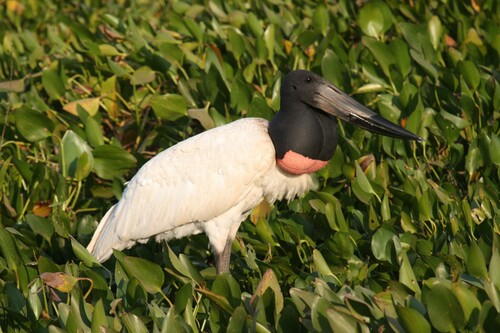
Jabiru
Jabiru mycteria
The tallest flying bird in South America, the Jabiru is a prehistoric-looking icon of the tropical wetlands. With its massive bill and striking red throat, it is a master of the marshes.
Quick Identification
Size
Height: 1.2–1.4 m (47–55 in); Wingspan: 2.3–2.8 m (7.5–9.2 ft); Weight: 5–9 kg (11–20 lbs)
Colors
Brilliant white body plumage with a featherless black head and upper neck; features a distinctive, bright red inflatable pouch at the base of the neck. Males and females are identical in color, though males are often significantly larger.
Key Features
- Massive black bill slightly upturned at the tip
- Featherless black head and neck
- Distensible bright red throat pouch
- Towering height and enormous wingspan
When You’ll See Them
Geographic range
Where Does the Jabiru Live?
The Jabiru is primarily a resident of South America, with its highest population densities found in the Pantanal of Brazil and the Eastern Chaco region of Paraguay. Its range extends north through Central America into Southern Mexico, and south into Northern Argentina. While they are considered tropical residents, they are known as wanderers; 'vagrant' individuals are occasionally spotted in the Southern United States, particularly in the wetlands of Texas, Oklahoma, and Louisiana.
Basemap © OpenStreetMap contributors
Behavior
The Jabiru is a patient and methodical hunter, often observed standing as still as a statue in shallow waters. It uses its massive bill to feel for prey in muddy water or to snatch unsuspecting fish with a lightning-fast strike. Despite their size, they are incredibly graceful in the air, utilizing thermals to soar to great heights, appearing as tiny white specks against the tropical sky. They are generally solitary hunters but will congregate in large groups at the end of the dry season when receding waters concentrate fish into small pools.
Socially, Jabirus are known for their spectacular nesting habits. They build enormous stick platforms, often 1 meter or more in diameter, in the tallest available trees. They are largely non-vocal, communicating through loud, rhythmic bill-clattering. While they are not typically aggressive toward humans, they are wary and will defend their nest sites vigorously from aerial predators or climbing mammals by snapping their heavy bills.
EverydayEarth exclusive
Camera Tips
To capture the Jabiru on a trail camera, placement is everything. These birds are giants, so you must mount your camera higher than you would for most backyard wildlife. A height of 3 to 5 feet is ideal, with the lens angled slightly upward if the bird is likely to stand close to the camera. Look for 'choke points' in wetlands—natural gaps in reeds or the edges of drying pools where fish are concentrated. This is where the Jabiru will spend hours foraging, giving you plenty of opportunities for high-quality triggers.
Because the Jabiru's plumage is a brilliant, reflective white, midday sun can easily overexpose your images, washing out all detail. Set your camera's exposure compensation to -1 if possible, or position the camera so it faces north or south to avoid direct sun flare. High-resolution video is preferred for this species; the way they move their red neck pouch and clatter their bills is a dynamic behavior that static photos often fail to do justice. Set your trigger interval to a shorter delay, as they tend to stay in one spot for long periods, allowing for multiple clips of their hunting behavior.
If you are lucky enough to have a nesting tree on your property, do not place cameras directly on the nesting tree, as Jabirus can be sensitive to disturbance during the egg-laying phase. Instead, use a camera with a long-range PIR sensor or a telephoto lens attachment placed on a neighboring tree. Jabirus are most active during the daylight hours, so you can save battery life by disabling night-time triggers, though they do occasionally move between roosts during a full moon.
Similar Species
Species that look similar or are commonly confused with Jabiru.
Frequently Asked Questions
Record Jabiru at your habitat
Connect a camera to start building your own species record — AI identifies every visitor automatically.