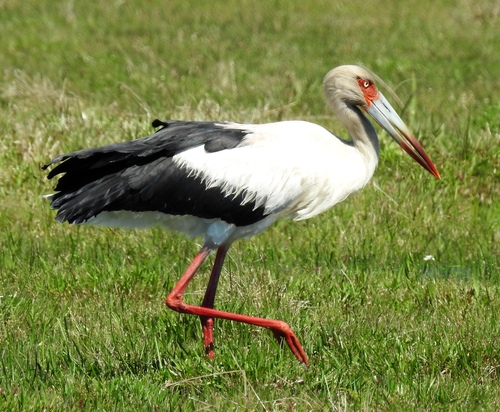
Maguari Stork
Ciconia maguari
Often mistaken for its European cousin, the Maguari Stork is a titan of the South American wetlands, standing nearly four feet tall with striking red facial markings. It is a master of the pampas, patrolling flooded grasslands with a slow, regal elegance.
Quick Identification
Size
Height: 97-120 cm (38-47 in); Wingspan: 150-180 cm (59-71 in); Weight: 3.4-4.5 kg (7.5-9.9 lbs)
Colors
Pure white plumage with black flight feathers and tail; featherless orange-red skin patch around the eyes; bluish-grey bill with a reddish tip; reddish-orange legs. Male and female appear identical.
Key Features
- Striking red facial skin around the eye
- Black flight feathers and tail contrasting with a pure white body
- Deeply forked tail (often hidden by white coverts)
- Thick, straight greyish-red bill
- Long, reddish-orange legs
When You’ll See Them
Geographic range
Where Does the Maguari Stork Live?
These majestic birds are native to the South American continent, primarily inhabiting the vast lowlands east of the Andes Mountains. Their core range stretches from the tropical llanos of Colombia and Venezuela down through the interior of Brazil, Paraguay, and Uruguay, reaching the temperate pampas of central Argentina. While they are occasionally spotted in coastal regions, they are most at home in the expansive, seasonally flooded grasslands of the interior.
Basemap © OpenStreetMap contributors
Behavior
Maguari Storks are highly social and conspicuous birds, often seen in small groups or large flocks where food is abundant. Unlike many of their relatives that prefer nesting in high treetops, Maguaris are versatile, frequently nesting in low bushes, reeds, or even on floating mats of vegetation in marshes. They are graceful fliers, utilizing thermal updrafts to soar over the South American plains with their long necks fully extended and legs trailing behind.
When foraging, they move with a slow, deliberate gait through shallow water or tall grass, stabbing at prey with their powerful, dagger-like bills. They are generally wary of human presence but can become accustomed to observers in agricultural areas or cattle ranches where they are not disturbed. During the breeding season, they perform elaborate greeting displays at the nest, including a characteristic bill-clattering and rhythmic neck-stretching.
EverydayEarth exclusive
Camera Tips
To capture high-quality footage of a Maguari Stork, position your camera near the edge of a shallow wetland or a seasonal pond. These birds prefer open areas with clear lines of sight, so avoid dense brush that might obstruct the camera’s PIR sensor or the view of the bird's long legs. Aim the camera at a height of about 2 to 3 feet (60-90 cm), angled slightly upward to frame the bird’s tall stature without cutting off its head or the tip of its bill.
Since Maguari Storks are highly visual hunters, they aren't attracted to traditional scent baits. Instead, look for natural 'funnels' like narrowing sections of a marsh or specific spots where fish or frogs are concentrated. If you are on a ranch or farm, placing a camera near a cattle watering trough or a freshly mown field can be very effective, as the birds often follow livestock or machinery to catch flushed insects and small vertebrates.
Set your camera to take high-resolution bursts or short video clips (15-20 seconds). These storks move slowly, so a short video often captures more interesting behavior—like the 'bill-clattering' greeting or the way they shake their foot to disturb prey in the mud—than a single still image. Ensure your trigger speed is fast, as they can strike at prey with surprising speed despite their generally slow gait.
Lighting is crucial for white-plumaged birds. To avoid 'blown-out' white feathers in bright sunlight, try to position your camera so it faces North or South to avoid direct morning or evening glare. If your camera allows for exposure adjustment, underexposing by one stop can help preserve the fine detail in their snowy-white feathers during the brightest parts of the day.
Similar Species
Species that look similar or are commonly confused with Maguari Stork.
Jabiru
Much larger with a bald black head and neck and a prominent red inflatable throat pouch.
Wood Stork
Smaller with a bald, scaly grey head and a curved bill, unlike the straight bill of the Maguari.
White Stork
Very similar in color but native to the Old World; the Maguari is larger and has a distinctive grey-based bill.
Frequently Asked Questions
Record Maguari Stork at your habitat
Connect a camera to start building your own species record — AI identifies every visitor automatically.