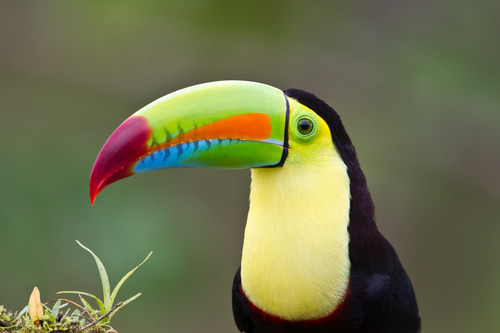
Keel-billed Toucan
Ramphastos sulfuratus
With its impossibly vibrant, oversized bill and striking yellow chest, the Keel-billed Toucan is the undisputed 'Ambassador of the Rainforest.' This social and playful bird brings a splash of tropical brilliance to any backyard it visits.
Quick Identification
Size
Length of 42 to 55 cm (17 to 22 inches); bill length up to 15 cm (6 inches); weight ranges from 380 to 500 grams (13 to 18 oz).
Colors
Predominantly black body with a vibrant lemon-yellow chest and throat. The massive bill features a blend of lime green, orange, red, and sky blue. Feet are bright blue and the undertail coverts are deep red. Males and females look similar, though males are slightly larger.
Key Features
- Massive multi-colored 'rainbow' bill
- Bright yellow throat and bib contrasting with black body
- Zygodactyl feet (two toes forward, two back) in bright blue
- White rump and red feathers under the tail
When You’ll See Them
Sightings on EverydayEarth
Apr 18, 2026
A vibrant Keel-billed Toucan perches on a mossy branch just above the fruit feeder, tilting its massive bill as it inspects the spread of bananas and papaya below. It shifts its weight and leans down toward the fruit during the bright morning hours.
Apr 7, 2026
A vibrant gathering occurs at the fruit feeder as a pair of Keel-billed Toucans arrive to forage. A male Crimson-backed Tanager is briefly seen moving through the vegetation near the food, while a Collared Aracari perches steadily on a branch to the right, observing the activity.
Mar 25, 2026
A Keel-billed Toucan visits the fruit feeder, using its large, colorful bill to pluck at a bunch of bananas. It moves along the platform, examining the sliced oranges provided.
Mar 24, 2026
A Keel-billed Toucan is perched on a diagonal branch in the upper-left background. It shows its iconic oversized bill and vibrant blue feet before shifting its position and moving further into the foliage.
Mar 24, 2026
A Keel-billed Toucan visits the fruit feeder, using its oversized, colorful bill to skillfully pluck and eat pieces of banana. It hops across the wooden platform, investigating the available orange slices between mouthfuls.
Mar 24, 2026
A Keel-billed Toucan visits the fruit feeder during a rain shower. It uses its large, colorful bill to pull pieces of fruit from a bunch of hanging bananas while smaller orange halves remain untouched on the platform below.
Geographic range
Where Does the Keel-billed Toucan Live?
This iconic bird is native to the tropical regions of the Americas, stretching from southern Mexico down through Central America to the northernmost parts of South America. Its core range includes the lush forests of Belize, Guatemala, and Costa Rica, extending into Colombia and northwestern Venezuela. As a lowland specialist, it is a quintessential resident of the Neotropical belt.
Basemap © OpenStreetMap contributors
Recorded on EverydayEarth
Behavior
They are surprisingly vocal for birds of their appearance, making a dry, rhythmic croaking sound similar to a tree frog. At night, they roost in tree hollows with several other individuals, often tucking their long bills under their wings and folding their tails over their backs to save space. While they are primarily canopy dwellers, they occasionally descend to lower levels for food or water, though they remain wary of ground-level predators.
EverydayEarth exclusive
Camera Tips
To capture the Keel-billed Toucan on camera, focus on the mid-to-upper canopy. If you have a backyard bordering a tropical forest, mounting your AI-powered camera on a high platform or a tall tree trunk facing a known fruiting tree, such as a Cecropia or wild nutmeg, is your best bet. Because they are shy around ground-level activity, an elevated position—at least 15 to 20 feet up—is essential for capturing natural, relaxed behavior. Ensure the camera has a clear line of sight to horizontal branches where they like to perch and 'hop' between feeding sessions.
While toucans don't visit traditional seed feeders, they are highly attracted to fruit. Planting native fruiting trees or safely securing a platform with halved papayas, bananas, or melons can lure them into the camera's field of view. Be mindful of the sun; the vibrant colors of their bill can 'wash out' or create glare in direct, harsh midday light. Position your camera to capture the softer morning light (6:00 AM to 9:00 AM), which will truly highlight the rainbow hues of their beak and the deep black of their plumage.
Because these birds are often in motion—tossing fruit or hopping—set your camera to a fast shutter speed or high-frame-rate video mode to avoid motion blur. If your camera supports it, a 'burst' photo mode is ideal for capturing the moment they catch a piece of fruit in mid-air. Since they are social, if you see one bird, keep the camera rolling; there are likely several more following close behind in a 'follow-the-leader' flight pattern.
Similar Species
Species that look similar or are commonly confused with Keel-billed Toucan.
Frequently Asked Questions
Record Keel-billed Toucan at your habitat
Connect a camera to start building your own species record — AI identifies every visitor automatically.