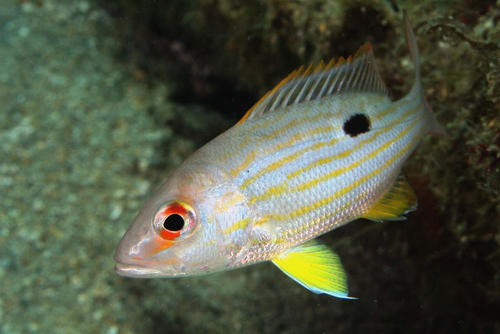
Lane Snapper
Lutjanus synagris
Featuring brilliant golden stripes and a signature black 'thumbprint,' the Lane Snapper is a colorful jewel of the Atlantic coast. This hardy and curious fish is a favorite for dockside observers and underwater explorers alike.
Quick Identification
Size
Typically 10-14 inches (25-35 cm) and 1-2 lbs (0.5-1 kg); can reach 24 inches (60 cm) and 8 lbs (3.6 kg).
Colors
Silvery-pink to reddish body with 8-10 horizontal yellow stripes and a distinct black spot below the dorsal fin.
Key Features
- Distinct black spot on the upper side below the dorsal fin
- 8-10 horizontal yellow stripes along the flanks
- Pinkish to reddish fins and tail
- Pointed snout with a large mouth and sharp teeth
When You’ll See Them
Geographic range
Where Does the Lane Snapper Live?
Where Does the Lane Snapper Live? This vibrant species is native to the warm tropical and subtropical waters of the Western Atlantic Ocean. Its core range extends from the southeastern coast of the United States and the Gulf of Mexico, through the entire Caribbean Sea, and down to the southern coast of Brazil. While they are most abundant in the West Indies, they are a common sight along the Florida coastline and the Bahamas wherever submerged structures provide adequate cover.
Basemap © OpenStreetMap contributors
Behavior
During the day, they tend to hover near structures for protection from larger predators like barracuda or grouper. As night falls, they become more active hunters, moving away from their shelters to forage over open sandy bottoms. Their social structure is less rigid than other schooling fish, often mixing with other snapper species of similar size while patrolling for food.
EverydayEarth exclusive
Camera Tips
To capture high-quality footage of Lane Snappers, the secret lies in 'structure and scent.' If you have a dock or pier, mount your underwater camera near the pilings roughly 2 to 4 feet above the sea floor. Lane Snappers love to hover in the 'dead water' created by these structures. Angle the camera slightly downward to catch them as they forage along the bottom, which is where they spend most of their active time. Using a wide-angle lens is vital because these fish often travel in small groups; a narrow field of view may only capture a tail or a nose as they dart by.
Baiting is highly recommended for backyard marine cameras. Use a weighted bait cage or a perforated PVC tube filled with frozen shrimp or oily fish scraps. Lane Snappers have an incredible sense of smell and will follow a chum trail from a distance. Position the bait about 3 to 5 feet away from the lens to ensure the fish stay within the focal range. If your camera setup allows for lights, use a red filter or low-intensity LED at night to observe their nocturnal hunting patterns without spooking them.
Water clarity is your biggest challenge. Aim to record during 'slack tide'—the brief period when the tide is neither coming in nor going out—as this is when sediment settles and visibility is highest. If you are using a trail camera looking down from a pier, use a circular polarizing filter to remove the sun's reflection on the water's surface. In summer months, look for increased activity during the new moon phase when these fish are often more active near the surface.
Similar Species
Species that look similar or are commonly confused with Lane Snapper.
Frequently Asked Questions
Record Lane Snapper at your habitat
Connect a camera to start building your own species record — AI identifies every visitor automatically.