Laughing Gull
Leucophaeus atricilla
With its iconic cackling call and striking black summer hood, the Laughing Gull is the spirited soundtrack of the American coastline. These bold, intelligent scavengers bring a touch of wild salt-air energy to every backyard and boardwalk they visit.
Quick Identification
Size
Length 36-41 cm (14-16 in); Wingspan 98-110 cm (39-43 in); Weight 200-370 g (7-13 oz)
Colors
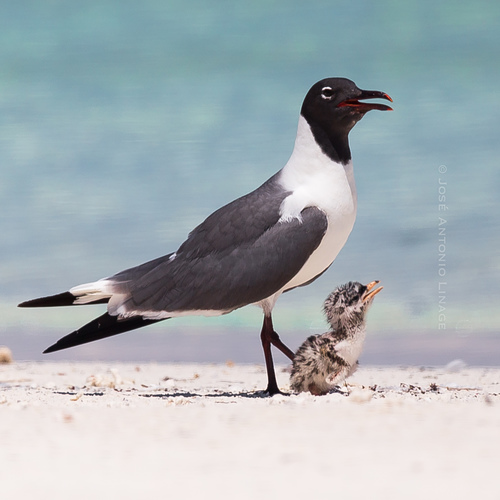
Breeding adults have a jet-black hood, dark gray wings with black tips, and white underparts. Non-breeding adults have a white head with a streaky gray smudge behind the eyes. Bills are dark red to black.
Key Features
- Deep black hood in breeding plumage with white eye crescents
- Distinctive, high-pitched 'ha-ha-ha' laughing call
- Dark slate-gray back and wings with no white mirror on tips
- Slender, slightly drooping dark reddish-black bill
When You’ll See Them
Geographic range
Where Does the Laughing Gull Live?
The Laughing Gull is a quintessential New World species, primarily native to the coastal regions of North and Central America. Its core range extends along the Atlantic coast from Atlantic Canada down through the Gulf of Mexico and throughout the Caribbean islands. While northern populations are migratory and winter in Central and northern South America, birds in the southern United States and the West Indies often remain residents year-round.
Basemap © OpenStreetMap contributors
Behavior
Laughing Gulls are highly social and energetic birds, best known for their raucous, cackling calls that sound remarkably like human laughter. They are opportunistic and bold, often found trailing fishing boats or patrolling beaches and parking lots for easy meals. Unlike some more solitary gulls, they nest in massive, noisy colonies, often numbering in the thousands, where they fiercely defend their nesting sites in coastal marshes.
Their interactions with humans are frequent and sometimes brazen; they have mastered the art of 'kleptoparasitism,' which involves stealing food directly from other birds like pelicans or even unsuspecting beachgoers. Despite their scavenging reputation, they are agile flyers and skilled hunters, frequently seen hovering over the surf before diving for small fish or snatching insects mid-air during inland excursions.
EverydayEarth exclusive
Camera Tips
To capture high-quality footage of Laughing Gulls, place your camera at a low angle near the ground, ideally 1-2 feet high. This 'bird's eye' perspective provides a much more intimate view of their facial expressions and social behaviors than a downward-facing angle. If you are near a coastal property, setting up near a birdbath or a shallow water feature can yield excellent results, as these gulls are frequent bathers and socializers.
Lighting is crucial when photographing white and gray birds. To avoid blowing out the white feathers on their chest, position the camera so the sun is behind it or at a slight angle during the 'golden hours' of early morning or late afternoon. This highlights the texture of their feathers and the deep black of their breeding hood. Avoid direct midday sun, which creates harsh shadows and loses detail in the dark hood.
While we don't recommend feeding wildlife, a shallow basin of fresh water is the best 'lure' for gulls in suburban coastal areas. They are highly attracted to the sound of splashing water. Ensure your camera's trigger speed is set to its fastest setting, as gulls are quick-moving birds; a delay of even half a second might result in a shot of a disappearing tail. Use a high-speed burst mode if available to catch the moment they spread their wings or engage in their signature 'laughing' display.
Similar Species
Species that look similar or are commonly confused with Laughing Gull.
Franklin's Gull
Smaller with a shorter bill and more extensive white markings on the black wingtips.
Ring-billed Gull
Features yellow legs and a yellow bill with a black ring, lacking the solid black hood of the Laughing Gull.
Bonaparte's Gull
Much smaller with bright orange-pink legs and a much daintier, thinner black bill.
Frequently Asked Questions
Record Laughing Gull at your habitat
Connect a camera to start building your own species record — AI identifies every visitor automatically.