Least Flycatcher
Empidonax minimus
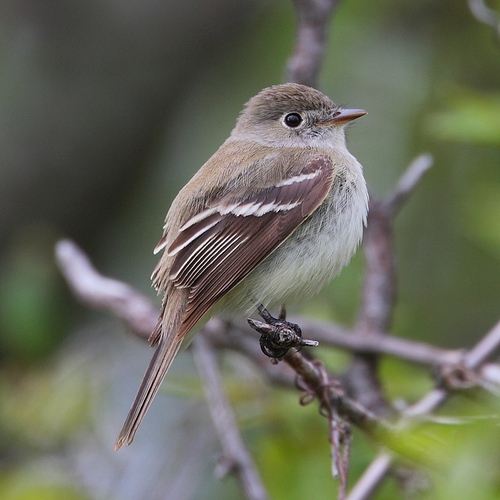
Small in size but big in personality, the Least Flycatcher is the smallest of its genus in eastern North America. Look for its snappy 'che-bec' call and distinctive white eye-ring in your backyard trees this summer.
Quick Identification
Size
Length: 12-14 cm (4.7-5.5 in); Wingspan: 19-22 cm (7.5-8.7 in); Weight: 8-12 g (0.28-0.42 oz)
Colors
Grayish-olive upperparts, whitish throat, pale yellow wash on the belly, and two distinct white wing bars
Key Features
- Bold white eye-ring
- Two distinct white wing bars
- Smallest Empidonax flycatcher in the East
- Short, wide bill with a pale lower mandible
When You’ll See Them
Geographic range
Where Does the Least Flycatcher Live?
The Least Flycatcher is a native of North America, primarily breeding across the southern half of Canada and the northern United States, from the Atlantic coast to the Rocky Mountains. During the autumn, these birds undertake a long-distance migration to their wintering grounds in Mexico and Central America, where they inhabit tropical scrub and open woodlands. While they are most concentrated in the Great Lakes and Appalachian regions during the summer, they can be spotted throughout the eastern and central flyways during their biannual travels.
Basemap © OpenStreetMap contributors
Behavior
When foraging, the Least Flycatcher employs a 'sit-and-wait' strategy. It perches upright on a branch, scanning the air for movement, before launching into a sudden, acrobatic flight to snatch an insect mid-air. Once the prey is captured, the bird typically returns to the same perch or one nearby to consume its meal. In suburban environments, they are relatively tolerant of people but remain high enough in the trees to stay out of direct reach.
EverydayEarth exclusive
Camera Tips
Because flycatchers are motivated by live prey, traditional bird feeders won't work. However, you can lure them into camera range by installing a moving water feature. A birdbath with a solar-powered 'wiggler' or a small fountain is irresistible to them, especially during the hot mid-summer months. They are frequent bathers and will often drop down from the canopy for a quick splash. Aim your camera at the water's edge or a nearby 'staging' twig where they might land to dry their feathers.
In terms of camera settings, speed is your friend. These birds move with lightning-fast, twitchy motions. Set your AI camera to a high sensitivity with a short trigger interval. If your camera supports video, use at least 30fps (60fps is even better) to capture their characteristic tail-flicks and rapid head movements. This motion is often the best way to distinguish them from other look-alike flycatchers in the field.
Seasonality plays a major role in camera success. Focus your efforts between late May and July when the birds are most territorial and active near their nesting sites. If your camera has an audio-triggering feature, the 'che-bec' song is a perfect sound signature to monitor. During the early morning hours, the light is often soft enough to capture the subtle olive-green tones of their plumage without the harsh shadows of the midday sun.
Similar Species
Species that look similar or are commonly confused with Least Flycatcher.
Willow Flycatcher
Lacks the bold white eye-ring of the Least Flycatcher and has a distinct 'fitz-bew' song.
Acadian Flycatcher
Larger with a significantly longer, broader bill and a more greenish overall plumage.
Eastern Wood-Pewee
Much longer wings and lacks the white eye-ring; usually perches higher in the canopy.
Frequently Asked Questions
Record Least Flycatcher at your habitat
Connect a camera to start building your own species record — AI identifies every visitor automatically.