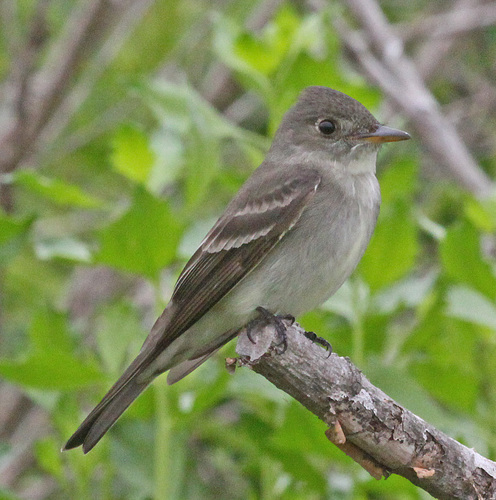
Eastern Wood-Pewee
Contopus virens
A subtle master of the forest canopy, the Eastern Wood-Pewee is famous for its haunting, namesake whistle that echoes through the trees. These agile flycatchers are a delight to observe as they perform acrobatic mid-air maneuvers to snag their prey.
Quick Identification
Size
Length: 5.9-6.3 in (15-16 cm); Wingspan: 9.1-10.2 in (23-26 cm); Weight: 0.3-0.7 oz (10-19 g)
Colors
Olive-gray upperparts with two pale wing bars; whitish throat and belly with a dusky wash on the sides. Bill features a dark upper mandible and a mostly yellow-orange lower mandible.
Key Features
- No prominent eye-ring
- Two distinct whitish wing bars
- Long wings that extend far down the tail when perched
- Frequent upright posture on dead branches
When You’ll See Them
Geographic range
Where Does the Eastern Wood-Pewee Live?
Native to the Americas, the Eastern Wood-Pewee is a long-distance migrant that breeds across the eastern half of North America, spanning from southeastern Canada down to the Gulf Coast. During the autumn, these birds embark on a massive journey through Central America to reach their wintering grounds in the tropical forests of northwestern South America. You will most commonly find them in the United States and Canada during the summer, while countries like Colombia, Venezuela, and Peru host the population during the northern winter months.
Basemap © OpenStreetMap contributors
Behavior
The Eastern Wood-Pewee is a patient and methodical hunter, known for its "sit-and-wait" strategy. It spends much of its day perched on dead branches in the mid-canopy, remaining nearly motionless until it spots a flying insect. When prey is sighted, the bird launches into an acrobatic flight, snapping the insect out of the air with an audible click of its bill before returning to the same or a nearby branch.
Socially, these birds are solitary and highly territorial during the breeding season. They are often heard before they are seen, using their namesake "pee-a-wee" whistle to mark their presence. Unlike many other backyard birds, they are late spring migrants, often arriving in the north only after the leaves have fully unfurled and the insect population is booming.
EverydayEarth exclusive
Camera Tips
To capture an Eastern Wood-Pewee on camera, focus your efforts on the "edge" zones of your property where woods meet an open lawn or field. These birds love horizontal, dead branches that offer a clear 360-degree view for hunting. Position your camera 10-15 feet off the ground, angled toward a prominent, leafless branch in the mid-canopy. If your camera is at ground level, you are unlikely to see them unless they descend for water.
Because pewees are small and fast, use a high-speed trigger setting on your AI camera. They often return to the exact same perch after a hunting sally, so if you catch a single frame of a bird flying away, keep your camera focused on that spot—it will likely be back within seconds. Early morning light is best for capturing the subtle olive and gray tones of their plumage without the harsh shadows of the midday canopy.
Audio is your secret weapon for this species. If your camera has a microphone, look for recordings that trigger on sound. The Eastern Wood-Pewee’s slurring whistle is one of the most distinct sounds of the eastern forest. Setting your camera to record short video clips when it hears high-pitched bird vocalizations can help you confirm the species even if the visual is slightly obscured by leaves.
Similar Species
Species that look similar or are commonly confused with Eastern Wood-Pewee.
Western Wood-Pewee
Nearly identical visually; distinguished by its harsher, descending 'breeeer' call and geographic range west of the Great Plains.
Eastern Phoebe
Lacks white wing bars and constantly pumps its tail up and down while perched.
Least Flycatcher
Much smaller with a bold white eye-ring and a shorter, flatter bill.
Frequently Asked Questions
Record Eastern Wood-Pewee at your habitat
Connect a camera to start building your own species record — AI identifies every visitor automatically.