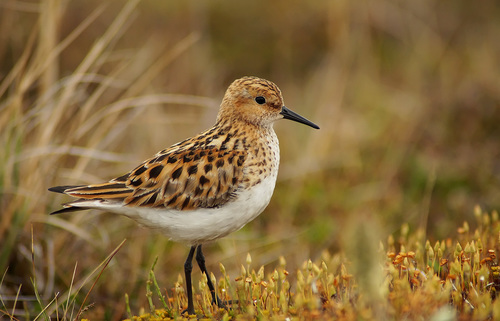
Little Stint
Calidris minuta
Meet the mighty traveler in a tiny package. The Little Stint is one of the world's smallest wading birds, undertaking epic annual migrations from the Arctic circle to the southern reaches of Africa.
Quick Identification
Size
Length: 12-14 cm (4.7-5.5 in); Wingspan: 28-31 cm (11-12.2 in); Weight: 17-35 g (0.6-1.2 oz)
Colors
Grey-brown upperparts and white underparts in winter; breeding adults show a rich rufous-orange wash on the head and mantle. Dark legs and a short, straight black bill.
Key Features
- Tiny size, barely larger than a sparrow
- Short, straight, needle-like black bill
- Dark legs and feet
- White 'V' or mantle stripes often visible on the back
- Rapid, energetic 'sewing machine' foraging motion
When You’ll See Them
Geographic range
Where Does the Little Stint Live?
The Little Stint is a world traveler, originating in the high Arctic tundra of Northern Europe and Siberia where it breeds during the short summer. As the seasons turn, these tiny birds embark on an epic journey to warmer climates, covering vast distances to reach their core wintering grounds in Africa, the Mediterranean basin, and across South Asia. While they are most concentrated in these regions, they are famous globetrotters, occasionally popping up as rare vagrants as far away as North America and Australia.
Basemap © OpenStreetMap contributors
Behavior
The Little Stint is an incredibly energetic wader, characterized by its rapid-fire feeding style where it probes the mud with the speed of a sewing machine. They are highly social birds, often forming large, dense flocks during migration and wintering periods. While they are generally wary of large predators, they can be surprisingly approachable if you remain still and low near a muddy shoreline.
During their long-distance migrations, these birds are known for their incredible endurance, traveling thousands of miles between the Arctic tundra and the southern tropics. In flight, the flock moves as a single, coordinated unit, flashing white underparts as they bank and turn in unison. They are rarely found alone, preferring the safety and social interaction of mixed-species groups with other small sandpipers like Dunlins or Curlew Sandpipers.
EverydayEarth exclusive
Camera Tips
To capture the Little Stint on camera, your best bet is to focus on the 'wetland edge.' Place your camera on a low tripod or a waterproof ground mount just inches above the waterline of a muddy bank or shoreline. The camera should be angled level with the ground to capture their tiny stature effectively; a top-down angle makes them look even smaller and loses the detail of their white underparts. Since these birds are very small, use a high-resolution setting and, if possible, a camera with a very fast trigger speed to freeze their rapid pecking motions.
Wait for the receding tide if you are in a coastal area, as this is when the birds are most active in the freshly exposed mud. In freshwater environments, look for areas with shallow, standing water and soft, exposed mud. You don't need traditional bait for these birds, but choosing a spot where you have previously seen other waders congregating is the best 'lure.' Using a camera with a burst mode or high-speed video is crucial, as their movements are incredibly quick and jittery, often resulting in motion blur on slower equipment.
Pay close attention to lighting and exposure. Because Little Stints have bright white underparts, they can easily be overexposed in bright midday sun, resulting in 'blown out' highlights. Early morning or late afternoon light provides a warmer glow and prevents the highlights from losing detail. If your camera allows for it, a narrow focus zone set right at the mud-water interface will ensure the tiny bird is in crisp focus when it enters the frame. Avoid using a flash, as it can reflect harshly off the water and mud, ruining the shot.
Similar Species
Species that look similar or are commonly confused with Little Stint.
Temminck's Stint
Temminck's has yellowish or greenish legs compared to the black legs of the Little Stint, and a more uniform, brownish-grey appearance.
Sanderling
Much larger and paler, Sanderlings lack a hind toe and are typically found running along the wash of sandy beaches rather than mudflats.
Frequently Asked Questions
Record Little Stint at your habitat
Connect a camera to start building your own species record — AI identifies every visitor automatically.