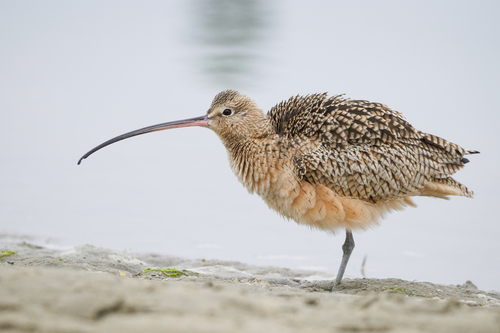
Long-billed Curlew
Numenius americanus
Meet the 'Sicklebird,' a master of the North American prairie and coastline boasting a bill that seems to go on forever. This elegant shorebird is a symbol of the wild, open spaces of the West.
Quick Identification
Size
Length: 50-65 cm (20-26 in), Wingspan: 62-90 cm (24-35 in), Weight: 445-950 g (1-2 lbs)
Colors
Buffy-cinnamon overall with fine dark mottling on the back; underwings are a distinct, bright cinnamon color easily seen in flight.
Key Features
- Exceptionally long, downward-curving bill (up to 8 inches in females)
- Warm cinnamon-colored underwings
- Long, bluish-gray legs
- Plain face without the dark stripes seen on other shorebirds
When You’ll See Them
Geographic range
Where Does the Long-billed Curlew Live?
Native to the North American continent, the Long-billed Curlew's core breeding range spans the Great Plains and the Intermountain West, stretching from southern Canada through the western United States. During the winter, these birds migrate toward the temperate coastlines of California, the Gulf of Mexico, and south through Mexico into parts of Central America. Because they rely on vast, open landscapes, their presence is a hallmark of healthy, contiguous grasslands and undisturbed coastal wetlands.
Basemap © OpenStreetMap contributors
Behavior
Long-billed Curlews are fascinating birds that split their time between two very different worlds. During the breeding season, they inhabit the wide-open shortgrass prairies and sagebrush steppes of the West, where they are known for their spectacular aerial displays and loud, haunting 'cur-lee' calls. They are highly territorial during this time, often mobbing potential predators like hawks or coyotes to protect their ground nests.
As winter approaches, they undergo a shift in both location and diet, moving to coastal mudflats, estuaries, and flooded agricultural fields. While they are often solitary foragers on their wintering grounds, they may gather in large communal roosts at night for protection. Their interaction with humans is usually wary; they require significant space and are highly sensitive to disturbance, especially when they have young chicks.
EverydayEarth exclusive
Camera Tips
Capturing a Long-billed Curlew on camera requires a strategy focused on wide-open spaces. If you live near grasslands or coastal wetlands, position your camera at a low height—roughly 1 to 2 feet off the ground—to capture their impressive profile. Because these birds are ground-nesters and ground-foragers, a low-angle shot is essential to showcase the sheer length of that iconic bill and their lanky, elegant legs. Aim the camera toward a natural clearing or a known foraging spot where the vegetation is short.
While you should not use food bait to attract them (as they are specialized foragers), water is an excellent lure. A large, shallow ground-level birdbath or a natural puddle in an open field can be a magnet for curlews looking to drink or bathe. Ensure the camera is oriented North or South to avoid lens flare from the rising or setting sun, which is when these birds are most active and the light is most flattering for their cinnamon plumage.
Patience is key with this species, as they are naturally skittish around human structures. Use a camera with a high-quality PIR (Passive Infrared) sensor to minimize false triggers from blowing grass, and consider a model with 'no-glow' infrared for night monitoring if you are near a roosting site, though daytime capture is far more rewarding. During the breeding season (April to June), be extremely careful not to disturb potential nesting sites, as these birds are sensitive to human presence near their eggs.
Similar Species
Species that look similar or are commonly confused with Long-billed Curlew.
Frequently Asked Questions
Record Long-billed Curlew at your habitat
Connect a camera to start building your own species record — AI identifies every visitor automatically.