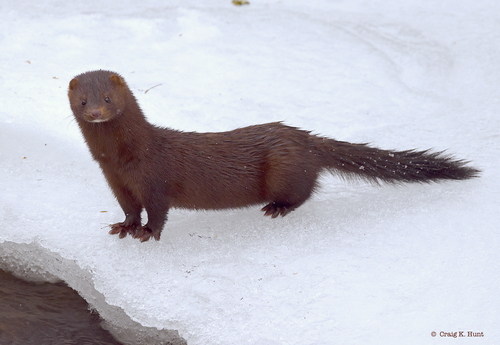
American Mink
Neogale vison
The American Mink is a sleek, chocolate-colored marvel of the wetlands, equally at home diving for fish or prowling the shoreline for prey.
Quick Identification
Size
Body length 13–18 in (33–45 cm), tail 5–10 in (13–25 cm); Weight 1.5–3.5 lb (0.7–1.6 kg)
Colors
Rich dark chocolate brown to near-black fur; distinctive white patch on the chin and occasionally the chest.
Key Features
- Sleek, elongated body with short limbs
- Bushy tail approximately one-third of total body length
- White patch on the chin or throat
- Partially webbed toes for swimming
When You’ll See Them
Geographic range
Where Does the American Mink Live?
Native to the vast majority of North America, the American Mink is found from the edge of the Arctic tundra down to the Gulf of Mexico. They are permanent residents across nearly all of Canada and the United States, only absent from the driest desert regions of the Southwest. Because of their history in the fur trade, escaped populations have established themselves as a successful, and often invasive, species throughout Europe, Russia, South America, and parts of Asia.
Basemap © OpenStreetMap contributors
Behavior
Mink are incredibly bold and inquisitive, often exploring every nook and cranny of a riverbank or backyard pond. They maintain several dens within their home range, often repurposing abandoned muskrat burrows or finding shelter in hollow logs and rock crevices. Their social life is minimal; they are strictly solitary except during the breeding season in late winter. To humans, they often appear as a dark, fast-moving blur near the water's edge, frequently pausing to stand on their hind legs to get a better view of their surroundings.
EverydayEarth exclusive
Camera Tips
To capture high-quality footage of an American Mink, placement is everything. These mustelids are 'edge' specialists, meaning they almost always travel along the immediate shoreline where water meets land. Position your AI camera on a narrow muddy bank, a fallen log crossing a stream, or a rocky outcropping near a pond. Set the camera low—roughly 6 to 10 inches off the ground—to capture their low-profile loping gait and the identifying white patch on their chin.
Mink move with surprising speed and erratic pauses. Because of this, use your camera's video mode rather than still photos. A 15–20 second clip is more likely to capture the mink’s fascinating hunting behaviors, such as 'snorkeling' (swimming with its head submerged) or standing on its hind legs to scent the air. If your camera has a 'high' sensitivity setting for the PIR sensor, enable it, as mink are smaller than many other backyard mammals and can sometimes move too fast for slower triggers.
While mink are naturally curious, you can increase your chances of a sighting by using a scent lure. A small amount of fish oil or a commercial trapping lure placed on a rock in front of the camera can encourage the mink to stop and sniff, giving you a perfect head-on shot. In the winter, mink are particularly active and their dark fur provides a stunning contrast against the snow. During this time, look for their distinctive 'two-print' bounding tracks in the mud or snow to find the best spot for your camera.
Similar Species
Species that look similar or are commonly confused with American Mink.
North American River Otter
Significantly larger with a much thicker, muscular tail and a broader, flatter muzzle.
Long-tailed Weasel
Much smaller and thinner with a white or yellowish belly and a black-tipped tail.
Fisher
Larger and more tree-dwelling, with a bushier tail and lacking the aquatic adaptations and white chin patch of the mink.
Frequently Asked Questions
Record American Mink at your habitat
Connect a camera to start building your own species record — AI identifies every visitor automatically.