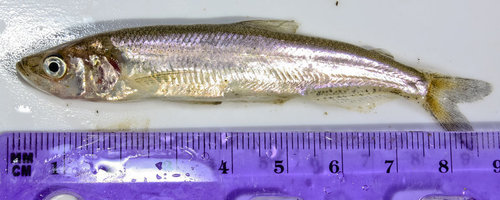
Longfin Smelt
Spirinchus thaleichthys
A shimmering silver resident of Pacific estuaries, the Longfin Smelt is a vital indicator of our coastal ecosystem's health. Known for its namesake fins and unique cucumber scent, this small fish plays a big role in the underwater world.
Quick Identification
Size
Typically 9 to 15 cm (3.5 to 6 inches) in length
Colors
Silvery-white sides with an iridescent sheen; olive to brownish-green on the back; translucent appearance in juveniles
Key Features
- Pectoral fins extending almost to the pelvic fins
- Small adipose fin near the tail
- Large mouth with fine teeth
- Slender, compressed body shape
When You’ll See Them
Geographic range
Where Does the Longfin Smelt Live?
Native to the cold, nutrient-rich corridors of the North Pacific, the Longfin Smelt inhabits the coastal waters of North America. Its range extends from the Prince William Sound in Alaska southward to the San Francisco Bay in California, which represents the southernmost limit of its distribution. While most populations are linked to the ocean, unique landlocked populations can be found in a few specific freshwater lakes in Washington and British Columbia, such as Lake Washington and Harrison Lake.
Basemap © OpenStreetMap contributors
Behavior
In their aquatic environment, they are highly social and form large schools to protect themselves from predators like salmon, birds, and marine mammals. Their movements are closely tied to the 'low-salinity zone' of estuaries, where they follow tidal currents to find optimal feeding grounds. Unlike stronger swimmers, they rely on the rhythmic flow of the tides to navigate the complex channels of coastal deltas.
While they are rarely seen by the average person due to their underwater habitat, they serve as a critical 'canary in the coal mine' for environmental health. Because they are sensitive to water quality and salinity changes, their population numbers are a primary indicator used by scientists to measure the ecological integrity of major watersheds like the San Francisco Bay and the Columbia River.
EverydayEarth exclusive
Camera Tips
Lighting is a critical factor for successful underwater footage. Longfin Smelt are crepuscular, meaning they are most active during the low-light hours of dawn and dusk. For the best results, use a camera equipped with high-sensitivity sensors or subtle infrared (IR) lighting that won't startle the school. Position your camera horizontally, roughly 10-15 cm (4-6 inches) above the riverbed, facing slightly upstream to catch the fish as they swim against the current toward their spawning grounds.
If your backyard borders a tidal slough or a coastal creek, you have a unique opportunity to see these fish. Avoid using bait, as Longfin Smelt are plankton feeders and are not easily lured by traditional fishing baits. Instead, focus on natural 'chokepoints' in the water where the current narrows, forcing the school to pass closer to your lens. High frame rates of 60fps or more are ideal to capture the quick, flickering movements of their silver bodies.
Be mindful of water clarity; after heavy rains, silt can cloud the view. The best footage is usually captured a day or two after a rain event when the water begins to clear but the 'scent' of the freshwater is still strong enough to pull the fish upstream. Always ensure your equipment is thoroughly cleaned after use in brackish water to prevent salt corrosion.
Similar Species
Species that look similar or are commonly confused with Longfin Smelt.
Frequently Asked Questions
Record Longfin Smelt at your habitat
Connect a camera to start building your own species record — AI identifies every visitor automatically.