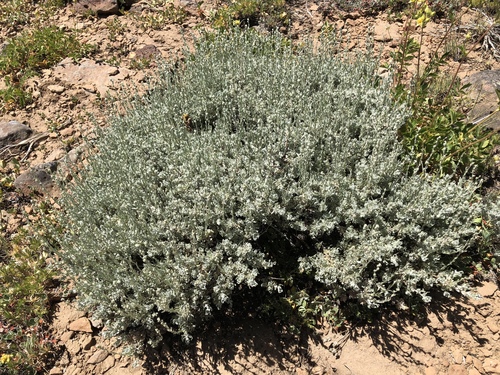
low sagebrush
Artemisia arbuscula
The low sagebrush is a master of the high desert, a dwarf shrub that provides critical food and shelter for iconic Western wildlife in the harshest rocky terrains.
Quick Identification
Size
A dwarf shrub reaching 10–40 cm (4–16 inches) in height with a spread of up to 50 cm (20 inches).
Colors
Silvery-gray to pale green foliage; older stems have dark brown to grayish shredded bark.
Key Features
- Dwarf, stunted growth habit rarely exceeding 16 inches
- Leaves are wedge-shaped with three distinct lobes at the tip
- Strong, pungent sage aroma when leaves are crushed
- Yellowish-brown flower heads appearing in late summer
When You’ll See Them
Geographic range
Where Does the low sagebrush Live?
Low sagebrush is a signature species of the Intermountain West in North America. Its native range spans the rugged interior of the United States, stretching from the eastern rain shadows of Washington and Oregon through the Great Basin of Nevada and California, and extending eastward into the high plains of Wyoming and Colorado. It is a specialist of the high desert, thriving in places where the soil is too poor or too rocky for larger sagebrush species to take root.
Basemap © OpenStreetMap contributors
Behavior
Low sagebrush is a slow-growing, long-lived perennial shrub designed for survival in the harshest conditions of the American West. Unlike its taller relatives, it is a specialist of 'scablands'—areas with shallow, rocky, or clay-heavy soils that undergo extreme cycles of saturation and drought. It remains evergreen throughout the year, using its silvery, hair-covered leaves to reflect intense desert sunlight and conserve moisture.
While the plant itself is stationary, it acts as a critical ecological anchor. It produces chemical compounds (terpenes) that deter many herbivores, yet it serves as an essential winter food source for specialized wildlife like pronghorn and sage-grouse. In the backyard or wild interface, it provides structural cover for ground-nesting birds and small mammals, creating a microhabitat that is significantly cooler than the surrounding exposed earth.
EverydayEarth exclusive
Camera Tips
To successfully capture wildlife visiting low sagebrush, you must account for its short stature. Mount your camera on a low stake just 12 to 18 inches above the ground. Because low sagebrush often grows in flat, featureless terrain, animals like the pygmy rabbit or sage-grouse rely on these small shrubs for shade and concealment. Aim your lens at a patch of low sagebrush that sits adjacent to a game trail or a clearing to catch animals as they transition between cover and open ground.
During the winter, low sagebrush becomes a focal point for activity because its tops often remain above the snowline when other forage is buried. This is the best time to capture mule deer and pronghorn browsing. Set your camera's PIR (Passive Infrared) sensor to high sensitivity, as the subtle movements of camouflaged birds like the Sage Thrasher against the grey-green foliage can be difficult for sensors to trigger at a distance.
Lighting is a major challenge in sagebrush habitats. The silvery leaves are highly reflective and can cause 'white-out' on your images during mid-day sun. To prevent this, face your camera North or South to avoid direct East-West sun glare. Using a wide-angle lens is preferable, as it allows you to capture the vast landscape while keeping the intricate details of the sagebrush in the foreground. If your camera supports time-lapse, try a 'long-term' setting—one photo a day—to watch the subtle yellow blooms emerge in late summer, a process that is otherwise easy to miss.
Similar Species
Species that look similar or are commonly confused with low sagebrush.
Frequently Asked Questions
Record low sagebrush at your habitat
Connect a camera to start building your own species record — AI identifies every visitor automatically.