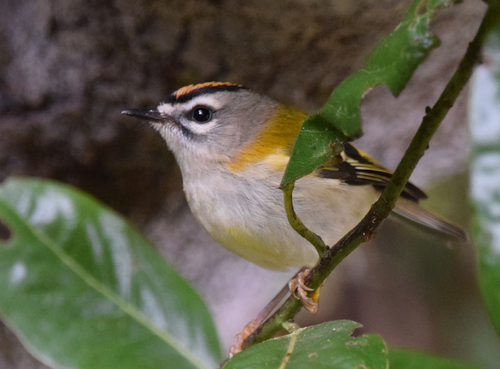
Madeira Firecrest
Regulus madeirensis
Madeira's smallest avian treasure, the Madeira Firecrest is a high-speed marvel of the North Atlantic. With its fiery crown and restless spirit, this endemic kinglet is a must-see for any backyard explorer on the island.
Quick Identification
Size
9–10 cm (3.5–3.9 in) long; 13–16 cm (5–6 in) wingspan; 5–7 g (0.18–0.25 oz) weight
Colors
Olive-green upperparts, off-white underparts, black eye-stripe, white eyebrow. Males have a bright orange crown; females have a lemon-yellow crown.
Key Features
- Vibrant orange or yellow crown feathers (the crest)
- Distinctive white supercilium (eyebrow) that is shorter than mainland relatives
- Black stripe running through the eye
- Two white wingbars on dark wings
- Constant, frantic wing-flicking behavior
When You’ll See Them
Geographic range
Where Does the Madeira Firecrest Live?
This miniature gem is native exclusively to the island of Madeira in the Macaronesia region of the North Atlantic. It is an island endemic, meaning it is found naturally nowhere else on Earth. Within its island home, it is remarkably widespread, occupying almost every available niche from the humid, misty forests of the northern slopes to the drier, manicured gardens found along the southern coastline. While it is most concentrated in the ancient laurel forests of the interior, it has successfully adapted to human-altered landscapes, making it a frequent visitor to backyard feeders and parks across the island.
Basemap © OpenStreetMap contributors
Behavior
The Madeira Firecrest is a bird of perpetual motion. It spends its daylight hours darting through the foliage of laurels and pines, rarely staying still for more than a second. It is known for its high-energy foraging style, which includes frequent hovering to snatch tiny insects from the undersides of leaves and rhythmic wing-flicking that helps flush out hidden prey. While they are tiny, they are surprisingly bold and can be quite inquisitive around humans if you remain still.
Socially, they are usually found in pairs or small family groups. During the breeding season, males become intensely territorial, raising their orange crests into a miniature mohawk to intimidate rivals. Their vocalizations are extremely high-pitched—so much so that some older birdwatchers may actually struggle to hear their thin, sibilant 'seet-seet-seet' calls. Despite their small size, they are hardy birds, well-adapted to the steep and rugged terrain of their volcanic island home.
EverydayEarth exclusive
Camera Tips
Capturing a Madeira Firecrest on camera requires speed and precision. Because these birds are so small and move so quickly, you should set your AI-powered camera to its highest sensitivity and use a 'Bird' or 'Small Animal' detection mode. To get the best results, position your camera just 1 to 2 meters away from a suspected foraging spot; they love the outer twigs of evergreen shrubs or the flowering tips of native plants like the Madeira Marguerite.
A shallow birdbath or a misting water feature is the ultimate secret weapon for attracting this species to your lens. Firecrests have high metabolic rates and need to bathe frequently to keep their feathers in top condition. Place your camera at eye-level with the water source, ensuring the background is slightly blurred to make the bird's vibrant crest pop. Early morning light is best, as it highlights the iridescent green of their back without creating the harsh shadows often found in the deep forest.
If you are using a trail camera with adjustable shutter speeds, aim for 1/1000th of a second or faster to freeze their frantic movements. Since they are year-round residents, you can capture them in any season, but the spring months (March to June) offer the best opportunity to record territorial displays. During this time, the males are more likely to flare their orange crests, providing a spectacular 'hero shot' for your collection.
Similar Species
Species that look similar or are commonly confused with Madeira Firecrest.
Frequently Asked Questions
Record Madeira Firecrest at your habitat
Connect a camera to start building your own species record — AI identifies every visitor automatically.