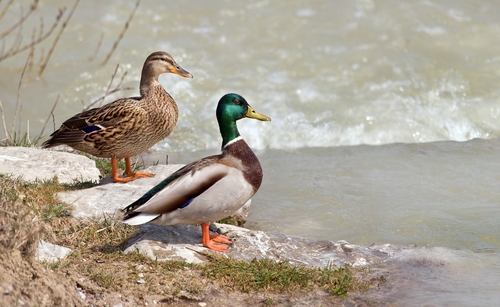
Mallard
Anas platyrhynchos
The iconic green-headed Mallard is the quintessential wild duck, found in almost every wetland and suburban pond across the globe. Highly social and surprisingly resilient, these birds offer a fascinating glimpse into the world of waterfowl right from your backyard camera.
Quick Identification
Size
Length: 50–65 cm (20–26 in); Wingspan: 81–98 cm (32–39 in); Weight: 0.7–1.6 kg (1.5–3.5 lbs)
Colors
Males have iridescent green heads, white neck rings, and chestnut breasts; females are mottled brown with dark eye-stripes. Both sexes have a blue wing patch (speculum) with white borders.
Key Features
- Iridescent bottle-green head and yellow bill (males)
- Mottled brown body with orange and black bill (females)
- Bright blue speculum (wing patch) bordered by white bars
- Tipped-up 'dabbling' feeding posture
When You’ll See Them
Sightings on EverydayEarth
May 27, 2026
A Bald Eagle is observed standing in its large stick nest during the night, perched over a mallard carcass brought in as food. The eagle is alert, occasionally turning its head to survey the darkened forest while the wind rustles the leaves of nearby trees. The mallard remains motionless in the center of the nest.
Geographic range
Where Does the Mallard Live?
Native across the vast temperate and subtropical regions of North America, Eurasia, and North Africa, the Mallard is one of the most widely distributed ducks in the world. Their core range extends from the Arctic tundra of Alaska and Canada down through the United States and across the entire European continent into Russia and Japan. Beyond their native lands, Mallards have successfully established thriving populations in the Southern Hemisphere, including Australia, New Zealand, and several South American countries like Brazil and Argentina.
Basemap © OpenStreetMap contributors
Recorded on EverydayEarth
Behavior
Mallards are social 'dabbling ducks,' a group characterized by their habit of feeding on the surface or by tipping their tails into the air to reach underwater plants. They are rarely seen alone, preferring the company of their own kind or other waterfowl in 'sords' or 'parvuls' (groups of ducks). During the day, they balance their time between foraging for food and 'loafing' on the banks of ponds or floating logs to preen their feathers and rest.
These ducks are highly adaptable and have developed a unique relationship with humans, often becoming quite tame in suburban environments. While they are strong flyers capable of migrating thousands of miles, many urban populations have become year-round residents. Their social structure is complex, featuring elaborate courtship displays in the winter and spring, followed by the female leading a line of ducklings to water shortly after they hatch.
EverydayEarth exclusive
Camera Tips
To capture the best footage of Mallards, position your camera very low to the ground—ideally just 6 to 12 inches high—facing the edge of a pond or a frequent 'loafing' spot like a flat rock or log. This low angle provides an intimate perspective of the bird and highlights the iridescent sheen of the male's head, which can look flat or black if filmed from too high up. Ensure the camera is angled to catch the morning or evening sun, as the 'golden hour' light makes their colors pop.
Because Mallards are often in motion while dabbling or preening, use a camera with a fast trigger speed and set it to take short video clips (10-15 seconds) rather than just still photos. If your camera allows, use a high frame rate to capture the rapid flapping of wings when they stretch or exit the water. Mallards are social, so a wider-angle lens is often better than a narrow zoom to ensure you capture the interaction between pairs or mother ducks and their ducklings.
While Mallards are naturally curious, you can encourage them to loiter in front of your lens by providing a safe foraging area. If local ordinances allow, a small amount of cracked corn or specialized waterfowl pellets placed on a flat, dry surface near the water's edge will keep them in the frame. Avoid placing the camera in areas with tall, moving reeds, as these will cause 'false triggers' in the wind and drain your battery quickly.
Similar Species
Species that look similar or are commonly confused with Mallard.
American Black Duck
Much darker chocolate-brown body and lacks the white borders around the blue wing patch found on Mallards.
Gadwall
Smaller and more understated; males are gray-brown with a black patch at the tail and a white (not blue) wing patch.
Wood Duck
Distinctive 'swept-back' crest on the head and much more intricate, multi-colored facial patterns than the Mallard.
Frequently Asked Questions
Record Mallard at your habitat
Connect a camera to start building your own species record — AI identifies every visitor automatically.