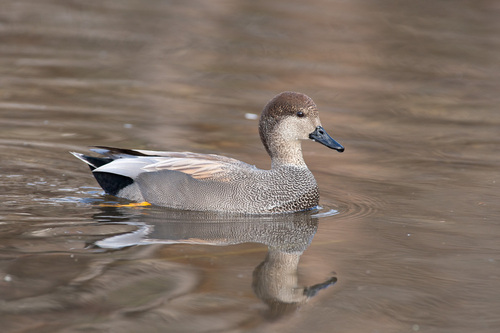
Gadwall
Mareca strepera
The Gadwall is the 'gentleman duck' of the wetlands, sporting sophisticated, understated patterns and a clever personality. Often found in quiet suburban ponds, this elegant dabbler is a reward for any patient backyard wildlife observer.
Quick Identification
Size
Length: 46–56 cm (18–22 in); Wingspan: 78–90 cm (31–35 in); Weight: 650–1,250 g (1.4–2.8 lbs)
Colors
Males are intricately patterned gray-brown with a distinct black rear; females are mottled brown with an orange-edged bill. Both sexes show a white wing patch.
Key Features
- Square-shaped head with a steep forehead
- Small white wing patch (speculum) visible in flight and sometimes at rest
- Male has a stark jet-black rump and tail-coverts
- Female has a thin, orange-sided bill and white belly
When You’ll See Them
Geographic range
Where Does the Gadwall Live?
The Gadwall is a widely distributed traveler of the Northern Hemisphere, found across vast stretches of North America, Eurasia, and North Africa. In North America, they breed primarily in the Great Plains and Great Basin, though their range has expanded significantly eastward into the Great Lakes and Atlantic coast over the last century. Across the Atlantic, they are common throughout Europe and Central Asia, with many populations migrating to the Mediterranean, India, and East Africa during the winter months to escape freezing waters.
Basemap © OpenStreetMap contributors
Behavior
Gadwalls are understated dabbling ducks, often overlooked because they lack the vibrant colors of Mallards or Wood Ducks. They are generally quieter and more reserved, preferring to feed in pairs or small groups. Unlike many other ducks, they are famous for 'kleptoparasitism'—frequently stealing bits of aquatic vegetation from diving birds like American Coots or diving ducks as they surface. This clever foraging strategy allows them to access nutrient-rich plants from deeper water that they couldn't reach by dabbling alone.
In social settings, they are less likely to approach humans for handouts than Mallards, maintaining a cautious distance in suburban ponds. They are most active during the day but can also be seen feeding under the light of a full moon. During the breeding season, males perform subtle displays, including a rhythmic 'burp' call while tossing their heads, though they remain one of the more soft-spoken members of the Anatidae family.
EverydayEarth exclusive
Camera Tips
To capture the best footage of Gadwalls, place your camera at the water's edge on a low-profile tripod or a secure rock. The ideal height is roughly 6 to 12 inches above the water line. Aim the lens toward floating mats of vegetation or shallow muddy banks where the ducks are likely to 'dabble' or rest. Because Gadwalls are more timid than Mallards, use a camera with a high-quality PIR (passive infrared) sensor that can trigger from a distance, or set a shorter trigger interval to ensure you catch them as they drift into the frame.
While Gadwalls aren't as attracted to typical birdseed as songbirds, a handful of cracked corn or specialized waterfowl pellets placed on a partially submerged log can serve as an effective lure. This encourages them to pause in front of the lens rather than drifting past. If your camera allows for custom settings, prioritize a high shutter speed. Even though they look calm, their head movements while feeding are quick, and a slow shutter will result in motion blur. Burst mode is excellent for capturing the moment they flap their wings to dry off, which is the best time to see their white speculum.
Pay close attention to the lighting. Gadwalls have subtle, 'scaly' feather patterns that are easily washed out in harsh midday sun. Positioning your camera to face north or south will prevent direct lens flare and take advantage of the 'golden hour' light in the early morning and late afternoon. This soft lighting brings out the rich textures of the male's gray plumage. During winter, look for them in mixed flocks; if you see American Coots on your camera, Gadwalls are likely nearby waiting to steal their food.
Similar Species
Species that look similar or are commonly confused with Gadwall.
Frequently Asked Questions
Record Gadwall at your habitat
Connect a camera to start building your own species record — AI identifies every visitor automatically.