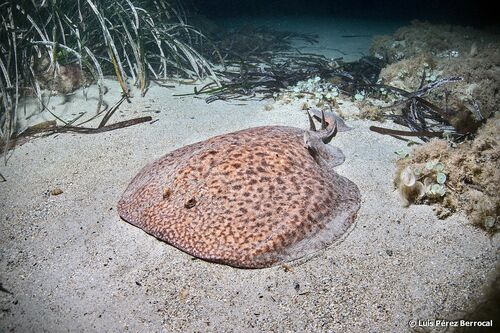
Marbled Torpedo
Torpedo marmorata
A master of bio-electric warfare, the Marbled Torpedo hides beneath the sand, ready to stun its prey with 80 volts of pure power.
Quick Identification
Size
Males range from 36–38 cm (14–15 in) while females are larger, typically 55–61 cm (22–24 in).
Colors
Mottled dark brown and tan dorsal surface creating a 'marbled' look; creamy white or beige underside.
Key Features
- Nearly circular pectoral fin disc
- Long, finger-like projections on the spiracle rims
- Two dorsal fins of nearly equal size located on a muscular tail
- Distinctive brown mottled camouflage pattern
When You’ll See Them
Geographic range
Where Does the Marbled Torpedo Live?
The Marbled Torpedo is native to the eastern Atlantic Ocean, with a wide range stretching from the southern North Sea and the British Isles down to the Cape of Good Hope in South Africa. It is a common inhabitant of the Mediterranean Sea and the coastal waters of West Africa, favoring the continental shelf. While it can be found in deep waters up to 370 meters, it is most frequently encountered by coastal observers in shallow, temperate to subtropical bays.
Basemap © OpenStreetMap contributors
Behavior
The Marbled Torpedo is a solitary, nocturnal predator that spends much of its day buried in the substrate. By using its pectoral fins to shovel sand or mud over its body, it becomes nearly invisible to both prey and predators, with only its eyes and spiracles (breathing holes) protruding from the sea floor. This sedentary lifestyle is supported by its ability to survive in low-oxygen environments, including shallow tidal pools.
When night falls, this ray becomes an active hunter, though it primarily relies on ambush tactics. It is famous for its pair of kidney-shaped electric organs located on either side of its head. These organs can generate a powerful electric discharge of up to 70–80 volts, which the ray uses to stun small fish or defend itself from threats. While generally sluggish, they can move surprisingly fast when pouncing on prey.
Socially, these rays are largely independent, only coming together for mating. They are ovoviviparous, meaning the young hatch from eggs inside the mother and are born live. For humans, they are generally docile but should be treated with respect; while their shock is rarely life-threatening, it is painful and can cause significant distress to unsuspecting swimmers or divers.
EverydayEarth exclusive
Camera Tips
To capture a Marbled Torpedo on camera, you need a specialized underwater setup or a waterproof trail camera capable of handling salt water. Since these rays are benthic (bottom-dwelling), mount your camera on a weighted low-profile tripod or a flat sand-plate just a few inches above the sea floor. Aim the lens toward the edge of a seagrass bed or a rocky reef where it meets a sandy patch, as these 'edge' zones are prime hunting grounds where rays transition between cover and open sand.
Because the Marbled Torpedo is nocturnal, lighting is your biggest challenge. Use external LED underwater lights with a red filter or infrared (IR) capability if your camera supports it. This ray has sensitive eyes and may flee if hit with a blast of high-intensity white light, but red light allows you to observe their natural foraging behavior without spooking them. Set your camera to record high-frame-rate video to catch the quick 'pounce' and electric strike, which happens in a fraction of a second.
For baiting, a mesh bag filled with oily fish scraps (like sardines or mackerel) secured near the camera's field of view can lure them in. However, ensure the bait is securely anchored so the ray doesn't swim away with it. Check the tides before deployment—the best footage is often captured during high tide in shallow bays when these rays move closer to shore to feed.
Similar Species
Species that look similar or are commonly confused with Marbled Torpedo.
Frequently Asked Questions
Record Marbled Torpedo at your habitat
Connect a camera to start building your own species record — AI identifies every visitor automatically.