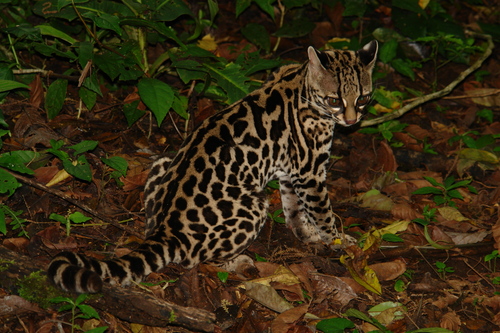
Margay
Leopardus wiedii
The Margay is nature’s ultimate high-wire act—a small wild cat capable of descending trees head-first and leaping through the canopy with breathtaking precision.
Quick Identification
Size
Body length of 45–80 cm (18–31 in) with a tail of 33–51 cm (13–20 in); weighs between 2.6–4 kg (5.7–8.8 lbs).
Colors
Tawny to ochre fur marked with rows of dark brown or black rosettes and longitudinal streaks; white underbelly and black-ringed tail.
Key Features
- Extraordinarily long tail, often exceeding the length of the hind leg
- Large, dark, prominent eyes adapted for nocturnal vision
- Ankles can rotate 180 degrees for head-first climbing
- Small, rounded ears with a distinct white spot on the back
When You’ll See Them
Geographic range
Where Does the Margay Live?
Native to the Western Hemisphere, the Margay’s range extends from the coastal lowlands of Mexico through the tropical corridor of Central America and deep into South America. It is most prevalent throughout the Amazon Basin and the Atlantic Forests, with its southernmost reaches extending into northern Uruguay and the northern provinces of Argentina. While they were historically found as far north as the Rio Grande Valley in Texas, they are now considered a strictly Neotropical species centered in humid, forested environments.
Basemap © OpenStreetMap contributors
Behavior
The Margay is the most accomplished climber of the cat family, often referred to as the 'acrobat of the jungle.' Unlike most felines, it possesses the unique physiological ability to climb down trees head-first and can even hang from branches by a single hind paw. This solitary and strictly nocturnal hunter spends the vast majority of its life in the forest canopy, rarely descending to the forest floor except to travel between non-contiguous patches of trees.
While they are extremely elusive and avoid human contact, Margays are known for their remarkable agility and specialized hunting techniques. They have been observed mimicking the calls of prey species, such as small monkeys, to lure them into range. In the wild, they maintain large home ranges that they mark with scent, though they are rarely seen by people due to their preference for dense, primary forest and their late-night activity patterns.
EverydayEarth exclusive
Camera Tips
Capturing a Margay on camera requires a shift in perspective. Because these cats are primarily arboreal, traditional ground-level trail camera sets often miss them entirely. For the best results, mount your cameras 3 to 6 meters (10 to 20 feet) high, aiming them along horizontal branches or 'arboreal highways' where vines and limbs create natural bridges. Look for thick, primary forest areas where the canopy is continuous.
Technical settings are crucial for this species. Margays are incredibly fast and agile, so use a camera with a trigger speed of 0.3 seconds or faster. High-speed burst mode or high-definition video is recommended to capture their fluid movement. Since they are strictly nocturnal, ensure your camera uses 'No-Glow' or 'Black Flash' infrared LEDs; standard red-glow IR can occasionally spook these sensitive felines, causing them to avoid the area in the future.
Scent lures can be a game-changer for attracting a Margay to your camera's field of view. While they are motivated by food, a long-range call lure or even a small amount of certain musky perfumes (like Calvin Klein Obsession for Men) applied to a nearby trunk can pique their curiosity and encourage them to pause in front of the lens. Always place the scent on a vertical trunk or branch about 12 inches from the camera's focal point.
Seasonality matters less than habitat quality for Margays, but they are most active during dry moonlit nights when arboreal travel is easier. If you are monitoring a forest edge or a plantation, position cameras during the transition periods of dusk and dawn, as they may move between dense cover and foraging spots during these twilight hours. Patience is key—they are low-density predators and may only pass a specific spot once every few weeks.
Similar Species
Species that look similar or are commonly confused with Margay.
Frequently Asked Questions
Record Margay at your habitat
Connect a camera to start building your own species record — AI identifies every visitor automatically.