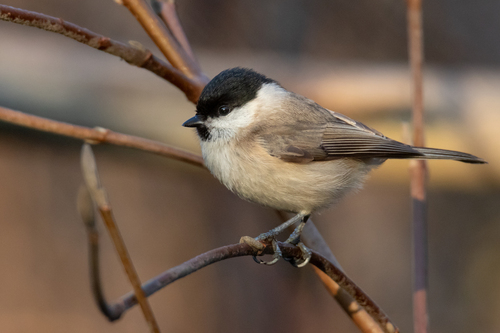
Marsh Tit
Poecile palustris
The Marsh Tit is a glossy-capped marvel of memory, famous for hiding thousands of seeds across its territory. A shy but charismatic visitor, it brings a touch of woodland mystery to mature backyard gardens.
Quick Identification
Size
Length: 11.5–12 cm (4.5–4.7 in); Wingspan: 18–20 cm (7.1–7.9 in); Weight: 10–13 g (0.35–0.46 oz)
Colors
Glossy black crown and nape, small black bib, off-white cheeks, brown-grey back, and buff-colored underparts. Sexes are identical.
Key Features
- Glossy black 'cap' extending to the nape
- Small, neat black chin-spot (bib)
- Uniform brown wings without a pale panel
- Distinctive 'pitchu' explosive call
When You’ll See Them
Geographic range
Where Does the Marsh Tit Live?
The Marsh Tit is a resident species found across the temperate latitudes of the Palearctic. Its native range spans from the United Kingdom and northern Spain across Central and Eastern Europe, extending through Russia into Northeast China, Korea, and Japan. While it is a permanent resident in most of its range, it avoids the high-latitude boreal forests of Scandinavia and the arid regions of the Mediterranean.
Basemap © OpenStreetMap contributors
Behavior
In social settings, they are generally shier than Great Tits or Blue Tits and rarely travel in large flocks. They are usually seen in pairs or as part of small, loose mixed-species foraging groups during the winter. When visiting a bird feeder, they typically dart in, grab a single seed, and fly off immediately to consume or cache it elsewhere, making them a challenge to spot for long periods.
Despite their name, they are not specifically tied to marshes. They are territorial year-round and rarely move far from their birthplace. Their flight is characteristic of the tit family—agile and slightly undulating—and they are often heard before they are seen, thanks to their loud and sneezing 'pitchu' call which is much more distinct than their visual appearance.
EverydayEarth exclusive
Camera Tips
Position your camera 3 to 5 feet from a 'staging branch' rather than the feeder itself. Marsh Tits are cautious and will almost always pause on a nearby twig to check for predators before committing to the feeder. This staging branch provides a more natural aesthetic and a more stationary subject for the AI to identify. Ensure the branch is in a well-lit area; since the main identifier is the 'glossy' black cap, capturing them in direct morning light will help distinguish them from the dull-capped Willow Tit.
In terms of placement, Marsh Tits prefer the cover of dense vegetation. Aim your camera toward the edges of thickets or mature hedges. They are rarely seen in the middle of open lawns, so keeping your gear close to the garden's 'wilder' edges will yield more frequent captures. During the winter, they are much bolder and more likely to visit consistently, so this is the best time to set up your observation post.
If you are using a bird box camera, be aware that Marsh Tits are secondary cavity nesters. They prefer natural holes in old trees but will use boxes with a 25mm-28mm entrance hole. Place the box between 2 and 4 metres high on a tree trunk, ideally shaded from direct midday sun and hidden by some light foliage to make the shy parents feel secure.
Similar Species
Species that look similar or are commonly confused with Marsh Tit.
Willow Tit
Has a dull (not glossy) black cap, a larger black bib, and a distinct pale patch on the closed wing.
Coal Tit
Features a prominent white patch on the back of its neck and two white bars on each wing.
Black-capped Chickadee
Found in North America; has a larger bib and more extensive white edging on the wing feathers.
Frequently Asked Questions
Record Marsh Tit at your habitat
Connect a camera to start building your own species record — AI identifies every visitor automatically.