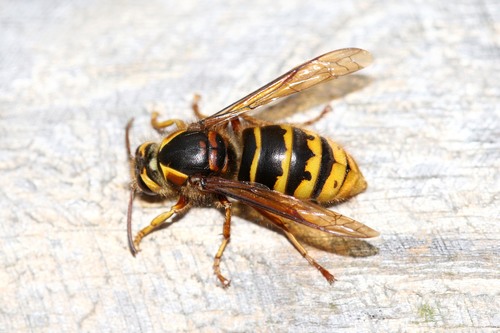
Median Wasp
Dolichovespula media
The Median Wasp is a master of aerial engineering, building impressive hanging paper nests in the heart of suburban gardens. Often mistaken for a hornet due to its size, this surprisingly docile wasp is a fascinating subject for any backyard observer.
Quick Identification
Size
Workers: 15–19 mm (0.6–0.75 in); Queens: up to 22 mm (0.87 in); Wingspan: 25–35 mm (1.0–1.4 in)
Colors
Bright yellow and black; queens often feature reddish-orange markings on the thorax similar to hornets; workers have narrow yellow stripes on the pronotum.
Key Features
- Hanging lemon-shaped paper nests in trees or shrubs
- Reddish-orange 'shoulders' on queens
- Deeply notched yellow inner margins of the eyes
- Abdomen features thin, wavy black bands rather than thick blocks
When You’ll See Them
Behavior
The Median Wasp is a social architect, best known for constructing distinctive, lemon-shaped paper nests that hang freely from branches rather than being hidden in wall cavities or underground. Unlike some of their more notorious cousins, they are generally peaceful neighbors. They are not prone to unprovoked aggression and typically only become defensive if a human or predator gets within a few feet of their aerial home.
Within the colony, these wasps exhibit fascinating social behaviors such as 'gastral vibration,' where adults tap their abdomens against the nest walls to signal to larvae during feeding time. They are remarkably hardy, often seen foraging in temperatures as low as 7°C (45°F), making them some of the earliest and latest wasps active during the day. They follow a relatively short colony cycle, usually concluding their business by September or October.
EverydayEarth exclusive
Camera Tips
Capturing the Median Wasp on camera is a rewarding challenge that requires focusing on their 'commuter routes' or their architectural marvels. Because they build aerial nests in shrubs, hedges, or under eaves, look for these golf-ball to football-sized grey paper structures starting in late spring. Mount your AI-powered camera on a tripod or nearby branch roughly 2 to 4 feet from the nest entrance. Ensure you have a clear line of sight and use a high shutter speed or 'Action' mode to freeze their rapid wing beats as they depart and arrive.
If you haven't located a nest, garden flowers are your best bet. Species like Cotoneaster, Figwort, and late-season Ivy are magnets for foraging workers. Position your camera about 12-18 inches from the blooms. Since these wasps are active even in cooler temperatures, don't be afraid to set your triggers for early morning when the dew is still present; the low-angle sun often catches the iridescent texture of their wings beautifully against the morning light.
To lure them into a specific frame for a close-up, a shallow dish containing sugar water or overripe fruit like plums, grapes, or fermented pears works wonders. Place the lure in a sunny spot to maximize the 'glint' off their yellow-and-black bodies. Set your camera to take short 5-10 second video clips rather than just stills; this allows you to capture their characteristic 'tail-wagging' behavior and the way they use their mandibles to process food.
Lastly, pay special attention to the queens in early May. They are significantly larger and often have reddish markings that make them look like European Hornets. To catch them on camera, focus on weathered wooden fences or garden furniture. Queens frequently visit these spots to scrape off wood fibers to create the paper pulp for their nests. A macro lens or a close-focus setting on your AI camera will reveal the incredible detail of their mouthparts as they work the wood.
Similar Species
Species that look similar or are commonly confused with Median Wasp.
European Hornet
The hornet is significantly larger (up to 35mm) and has much more extensive reddish-brown coloring on its head and the entirety of its thorax.
Saxon Wasp
Very similar aerial nesting habits, but the Saxon Wasp typically has a different facial pattern, usually featuring a single small black dot or no mark at all on the clypeus.
Frequently Asked Questions
Record Median Wasp at your habitat
Connect a camera to start building your own species record — AI identifies every visitor automatically.