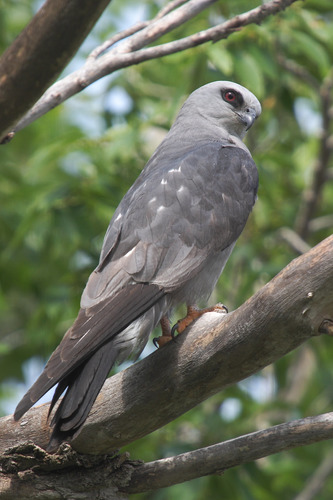
Mississippi Kite
Ictinia mississippiensis
The Mississippi Kite is a master of the summer skies, known for its sleek silver plumage and incredible aerial agility. Often seen gliding effortlessly over southern suburbs, these social raptors are a favorite for backyard birders.
Quick Identification
Size
Length: 30–37 cm (12–15 in); Wingspan: 75–83 cm (30–33 in); Weight: 215–390 g (7.6–13.8 oz)
Colors
Adults are primarily pearl-gray on the head, fading to a darker slate-gray on the back and wings. They feature a square black tail and striking red eyes. Juveniles are brownish and heavily streaked with white.
Key Features
- Long, narrow, pointed wings
- Square-tipped black tail
- Red eyes in adults
- Graceful, buoyant flight pattern
When You’ll See Them
Geographic range
Where Does the Mississippi Kite Live?
Native to the Americas, the Mississippi Kite is a long-distance traveler that breeds across the southern and central United States, from the Atlantic coast through the Gulf States and into the Great Plains as far north as Kansas. During the autumn months, they embark on an incredible journey south through Central America to spend their winter in the tropical savannas and woodlands of central South America, particularly in Argentina, Paraguay, and Brazil. This seasonal movement makes them a beloved summer visitor for birdwatchers across their North American breeding grounds.
Basemap © OpenStreetMap contributors
Behavior
Mississippi Kites are exceptionally graceful raptors, frequently observed performing effortless aerial acrobatics as they hunt. Unlike many birds of prey that prefer solitary life, these kites are highly social and often nest in loose colonies. They spend a significant portion of their day on the wing, utilizing thermals to glide over open landscapes and suburban neighborhoods with minimal flapping.
During the nesting season, they can become notably territorial. It is not uncommon for homeowners in the southern United States to find these birds nesting in tall backyard trees. While generally peaceful, they are known to dive-bomb perceived threats—including humans or pets—that venture too close to their nesting site. They are unique in that they often catch and consume their prey, primarily large insects, while still in flight.
EverydayEarth exclusive
Camera Tips
Capturing a Mississippi Kite on a backyard camera requires looking up. Because these birds spend the vast majority of their time high in the canopy or soaring in the sky, standard fence-post camera placements rarely work. If you have tall hardwoods like oaks or pecans, try mounting your AI-powered camera on a high branch or using a specialized pole mount angled toward the upper third of the tree line. This is where they are most likely to perch to scan for prey or tend to their nests.
Traditional bird feeders won't attract these raptors, but maintaining a wildlife-friendly yard that supports large insects will. Avoid using broad-spectrum pesticides; a healthy population of cicadas and dragonflies is the ultimate lure for a Mississippi Kite. If you have a large open yard, positioning a camera to face a wide patch of sky during the peak heat of the day (when thermals are strongest) can help you capture their incredible hunting maneuvers.
For camera settings, prioritize a high shutter speed. These birds are master aeronauts and can change direction in a heartbeat; a slow shutter will result in a gray blur. If your camera supports 'Pre-Roll' or high-speed triggering, enable it to catch the moment they dive. Because they are migratory, ensure your cameras are active and optimized from late April through August, as they will disappear almost overnight once September arrives.
Similar Species
Species that look similar or are commonly confused with Mississippi Kite.
Swallow-tailed Kite
Much larger with a deeply forked 'swallow' tail and striking black-and-white contrast.
Northern Harrier
Has a distinct white rump patch and flies low over marshes with wings in a 'V' shape.
Peregrine Falcon
Heavier build with a distinct dark 'mustache' or hood and much more powerful, rapid wingbeats.
Frequently Asked Questions
Record Mississippi Kite at your habitat
Connect a camera to start building your own species record — AI identifies every visitor automatically.