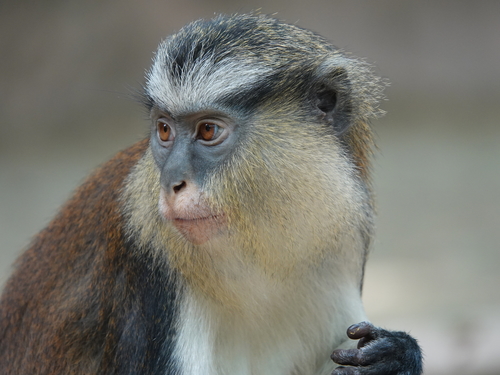
Mona Monkey
Cercopithecus mona
With its striking blue-grey face and acrobatic spirit, the Mona Monkey is a jewel of the West African canopy. Equally at home in the forests of Nigeria or the spice groves of Grenada, this social guenon is a master of the high-wire act.
Quick Identification
Size
Body length 32-53 cm (12-21 in); tail length 67-90 cm (26-35 in); weight 2.5-5.3 kg (5.5-11.7 lbs)
Colors
Brown speckled (agouti) back, creamy white belly and rump patches, black limbs and tail, blue-grey face with a dark eye-stripe
Key Features
- Distinctive white patches on either side of the tail base
- Dark horizontal stripe running from ears through the eyes
- Long, slender black tail significantly longer than the body
- White or yellowish cheek whiskers and a pinkish muzzle
When You’ll See Them
Geographic range
Where Does the Mona Monkey Live?
The Mona Monkey is native to the tropical belt of Western Africa, with a core range extending from eastern Ghana through Togo, Benin, and Nigeria, reaching into western Cameroon. Interestingly, this species also thrives as an introduced population on the Caribbean island of Grenada, where they were brought via ships during the 18th century. In both their native and introduced ranges, they prefer lush, forested environments near water sources.
Basemap © OpenStreetMap contributors
Behavior
The Mona Monkey is a highly social and energetic primate that lives in multi-tiered societies, typically forming groups of 15 to 35 individuals. These groups are usually led by a single dominant male, though all-male 'bachelor' groups are also common. They are primarily arboreal, moving through the middle and upper canopy with impressive agility, often making daring leaps between trees. They are known for their vocal nature, using a series of 'boom' and 'hack' calls to communicate alarm or maintain group cohesion.
These monkeys are diurnal and spend a significant portion of their day foraging. While they are wary of humans in areas where they are hunted, in protected regions or in Grenada, they can become quite bold and habituated to human presence. They possess large cheek pouches which they use like grocery bags to store food gathered quickly in vulnerable areas, allowing them to retreat to the safety of the high canopy to eat in peace.
EverydayEarth exclusive
Camera Tips
Capturing the Mona Monkey on camera requires a bit of elevation. Because they are primarily arboreal, mounting your camera 10 to 15 feet up a tree trunk, angled slightly downward toward a known 'travel highway'—thick, horizontal branches they use to traverse the canopy—is your best bet. If you are restricted to ground-level mounting, look for areas where the canopy breaks, such as near forest edges or small clearings with fruiting trees, where they may descend lower to forage.
Fast shutter speeds are essential for this species. Mona Monkeys are incredibly twitchy and fast-moving; a slow trigger speed will result in nothing but a blurry tail in your frame. Set your camera to burst mode to capture the sequence of their movement. If your camera supports it, high-definition video is often better than stills for observing their complex social interactions and cheek-pouch stuffing behavior.
In terms of timing, focus on the early morning hours just after sunrise when the group begins their first foraging trek. If you are on private land and looking to attract them for a better shot, native fruiting trees are the best natural lure. Avoid artificial baits in the wild to prevent habituation. During the dry season, a consistent water source on the ground can occasionally draw them down for a drink, providing a rare opportunity for eye-level photography.
Similar Species
Species that look similar or are commonly confused with Mona Monkey.
Frequently Asked Questions
Record Mona Monkey at your habitat
Connect a camera to start building your own species record — AI identifies every visitor automatically.