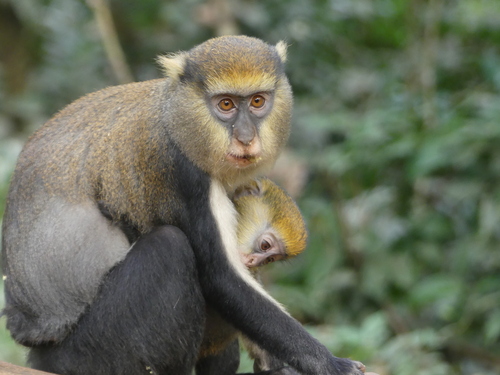
Lowe's Monkey
Cercopithecus lowei
Meet Lowe's Monkey, the agile acrobat of the West African canopy. Known for its striking white brow and complex social life, this charismatic primate is a master of life in the treetops.
Quick Identification
Size
Head-body length of 35-55 cm (14-22 in) with a tail reaching 50-80 cm (20-31 in); weight ranges from 2.5-6 kg (5.5-13 lbs)
Colors
Olive-brown or grizzled-green upperparts with a creamy white or yellowish underbelly; dark limbs and a bluish-grey face with a prominent yellowish-white horizontal brow band.
Key Features
- Distinct yellowish-white horizontal brow band
- Long, dark, non-prehensile tail used for balance
- White throat and chest contrasting with dark limbs
- Small, rounded ears hidden in fur
When You’ll See Them
Geographic range
Where Does the Lowe's Monkey Live?
Native to the tropical regions of West Africa, Lowe's Monkey is a specialist of the Upper Guinean forest block. Its primary range extends from the central Ivory Coast—specifically east of the Bandama River—through the forested southern half of Ghana, reaching as far east as the Volta River. As a resident species, it does not migrate, though its local movements are dictated by the seasonal ripening of fruit within its forest home.
Basemap © OpenStreetMap contributors
Behavior
In areas where their habitat meets human settlements, they can be quite bold, sometimes raiding backyard fruit trees or cocoa plantations. Despite this occasional proximity to humans, they remain wary and will quickly retreat to the high canopy if they feel threatened. Their daily routine involves a morning period of intense foraging, followed by a midday rest and grooming session, and a second feeding bout in the late afternoon before settling into high, leafy 'sleeping trees' for the night.
EverydayEarth exclusive
Camera Tips
To successfully capture Lowe's Monkey on camera, height is your most important factor. These monkeys are primarily arboreal and rarely descend to the forest floor unless water is scarce or fruit has fallen. Mount your camera at least 3 to 5 meters (10-15 feet) high, ideally on a sturdy trunk overlooking a known 'canopy bridge'—a place where branches from neighboring trees overlap, creating a natural highway for primates. Angling the camera slightly downward across a horizontal limb will provide the best profile shots.
While traditional baiting isn't recommended for wild primates, placing your camera near naturally occurring food sources is highly effective. Identify fruiting trees such as wild figs, oil palms, or umbrella trees. If you have a backyard garden in their range, targeting a fruiting mango or papaya tree during the ripening season is almost guaranteed to attract a troop. Because these monkeys move in groups, set your camera to 'Burst Mode' or 'Multi-Shot' (3-5 frames) to ensure you capture the whole family and not just the tail of the first monkey to jump past.
Video mode is particularly rewarding for this species. Lowe's Monkeys are vocal and expressive; a 20-second 4K video clip will capture their social grooming, vocalizations, and the unique way they use their tails for balance. Ensure your camera has a fast trigger speed (0.3 seconds or less), as guenons are notoriously quick. If your camera allows for it, set the PIR sensitivity to 'High' to compensate for the distance and the heat-shielding effect of the dense tropical foliage.
Similar Species
Species that look similar or are commonly confused with Lowe's Monkey.
Campbell's Monkey
Found west of the Bandama River; has a more silvery-grey cast to the fur and a slightly different vocalization pattern.
Mona Monkey
Found further east (Nigeria/Cameroon); features a more prominent white rump patch and reddish-brown back.
Lesser Spot-nosed Monkey
Smaller with a very distinct white heart-shaped spot on the nose, lacking the horizontal brow band of Lowe's Monkey.
Frequently Asked Questions
Record Lowe's Monkey at your habitat
Connect a camera to start building your own species record — AI identifies every visitor automatically.