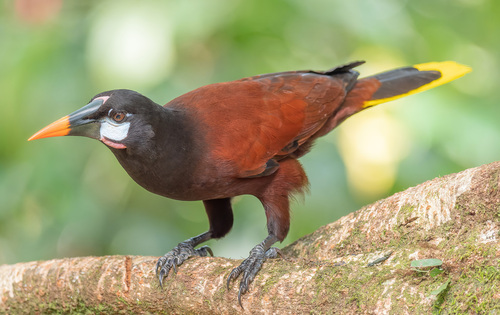
Montezuma Oropendola
Psarocolius montezuma
The architect of the tropical canopy, the Montezuma Oropendola is famous for its massive hanging nests and a call that sounds like a bubbling brook.
Quick Identification
Size
Males are much larger than females; 43-50 cm (17-20 in) and 520g for males, 38 cm (15 in) and 230g for females.
Colors
Rich chestnut body with a black head and chest; tail is primarily bright yellow with dark central feathers; bill is black with a bold orange-red tip; bare facial skin is pale blue or white.
Key Features
- Large hanging pendulous nests often 1-2 meters long
- Bright yellow outer tail feathers visible in flight
- Black bill with a distinct reddish-orange tip
- Bare blue-white skin patches on the face
- Dramatic bowing display accompanied by a liquid gurgling call
When You’ll See Them
Geographic range
Where Does the Montezuma Oropendola Live?
Native to the tropical regions of the Americas, the Montezuma Oropendola is a quintessential species of the Caribbean lowlands. Its territory extends from southeastern Mexico down through Belize, Honduras, and Nicaragua, reaching high densities in the lush forests of Costa Rica and central Panama. While they are primarily found on the Atlantic slope, they have also established populations in specific Pacific-side regions where the habitat remains sufficiently humid.
Basemap © OpenStreetMap contributors
Behavior
The Montezuma Oropendola is a highly social bird known for its incredible colonial nesting habits. They live in groups where a single dominant male typically oversees a harem of females. The most striking behavior is the male's courtship display: he tips forward on a branch, sometimes hanging nearly upside down, while vibrating his wings and producing a complex, bubbling, and gurgling song that sounds like water pouring from a carafe.
These birds are loud and active, spending their days foraging in the canopy or moving between their nesting colonies and feeding sites. While they are generally wary of humans, they have adapted well to modified landscapes like cacao and banana plantations, as long as tall, isolated trees remain available for their heavy hanging nests.
EverydayEarth exclusive
Camera Tips
To capture the Montezuma Oropendola on camera, height is your best friend. Because they are canopy-dwellers, placing your AI-powered camera on a high balcony or using a pole-mounted setup near the mid-story of the forest edge will yield the best results. If you have a tall 'emergent' tree nearby—one that stands taller than the surrounding canopy—point your camera toward its upper branches, as these are preferred lookout spots for dominant males.
In a backyard setting, these birds are strongly attracted to large fruit feeders. A platform feeder stocked with overripe bananas or plantains is the most effective lure. Since they are large birds that often travel in groups, ensure your feeder is sturdy and has plenty of landing space. Set your camera’s trigger sensitivity to high; their bowing displays are fast and energetic, and you don’t want to miss the moment they flip upside down.
Pay attention to the light. The chestnut feathers of an Oropendola can look dull in deep shade but glow with a rich metallic sheen in direct morning sun. Position your camera facing away from the sunrise to capture the full brilliance of their plumage. If you are lucky enough to have a nesting colony nearby, keep your distance—use a long-range lens or a remote camera to avoid disturbing the colony, as they are sensitive to ground-level activity during the egg-laying phase.
Similar Species
Species that look similar or are commonly confused with Montezuma Oropendola.
Frequently Asked Questions
Record Montezuma Oropendola at your habitat
Connect a camera to start building your own species record — AI identifies every visitor automatically.