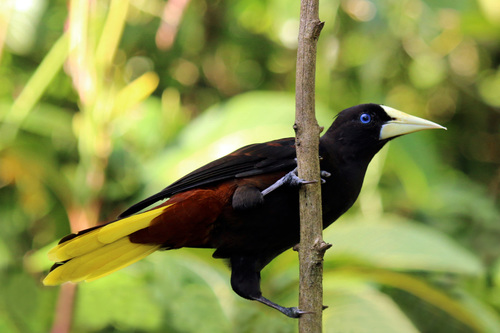
Crested Oropendola
Psarocolius decumanus
Master architects of the tropical canopy, Crested Oropendolas are famous for their hanging teardrop nests and liquid, gurgling songs. With their striking yellow tails and ivory bills, they are a crown jewel of South American backyard birdwatching.
Quick Identification
Size
Males are 43–48 cm (17–19 in) and 300g (10.6 oz); females are smaller at 35–39 cm (14–15 in) and 180g (6.3 oz).
Colors
Deep chestnut to blackish body, bright yellow outer tail feathers, pale ivory bill, and piercing blue irises.
Key Features
- Large, pale ivory-white bill
- Vibrant yellow outer tail feathers visible in flight
- Striking blue eyes
- Small, thin hair-like crest on the crown
- Deep chestnut rump and undertail coverts
When You’ll See Them
Sightings on EverydayEarth
Apr 3, 2026
A Crested Oropendola is perched on a moss-covered branch, displaying its distinctive chestnut rump and yellow tail feathers as it moves. Another large bird is partially visible in the foliage behind it. A Blue-gray Tanager soon flies in and lands on the feeding tray, which is stocked with fresh orange slices.
Apr 3, 2026
A Crested Oropendola is perched on the feeder tray, diligently eating from the orange slices. A Blue-gray Tanager makes a very brief appearance, landing on the tray for a second before flying away while the larger bird continues its meal.
Mar 28, 2026
A Crested Oropendola is perched on the feeding platform, actively feeding on orange slices. It uses its large bill to probe the fruit before pausing to scan the lush tropical environment. At the end of the sequence, the bird takes flight just as another smaller, yellow-and-black bird briefly passes through the background.
Mar 27, 2026
A Crested Oropendola is perched on the edge of the feeder tray, using its pointed bill to eat from the halved oranges. It shifts its weight and turns its head, showing the distinctive yellow feathers on its tail against the lush, green tropical background.
Mar 27, 2026
A group of Crested Oropendolas are gathered on the feeding platform. They are actively using their large, ivory-colored bills to peck and feed on several orange halves. One individual on the left is particularly focused on a single piece of fruit while others stand nearby.
Mar 27, 2026
A busy morning at the fruit feeder in Panama. A large Crested Oropendola dominates the center of the platform, feeding on halved oranges. Several Clay-colored Thrushes move around the edges of the tray, while a male Crimson-backed Tanager makes a brief appearance in the surrounding vegetation.
Geographic range
Where Does the Crested Oropendola Live?
Native to the tropical heart of South America and southern Central America, the Crested Oropendola is a quintessential bird of the lowlands. Its core range stretches from the Caribbean coast of Panama and Colombia, through the Amazon basin to northern Argentina, and includes the islands of Trinidad and Tobago. They are incredibly adaptable, flourishing anywhere that tall trees provide nesting sites near open areas for foraging.
Basemap © OpenStreetMap contributors
Recorded on EverydayEarth
Behavior
The Crested Oropendola is a highly social and boisterous bird, famous for its colonial nesting and incredible vocal repertoire. In the canopy, they are impossible to miss, often heard before they are seen due to their 'liquid' gurgling calls and crashing wing-beats. During the breeding season, males perform an acrobatic display where they bow forward until they are nearly upside down on a branch, fluttering their wings and making a loud, wheezing gurgle to attract females.
These birds are master architects. Females work together to weave long, pendant-shaped nests made of fibers, vines, and grasses that hang like giant teardrops from the tips of branches. A single tree may host dozens of these nests, guarded by a dominant male who fends off rivals and predators. They are bold and intelligent birds, often seen in mixed-species flocks with other large icterids while foraging for food.
EverydayEarth exclusive
Camera Tips
To capture the best footage of Crested Oropendolas, you need to think vertically. Because they are canopy dwellers, a camera placed at ground level will often only see them as dark silhouettes against a bright sky. If you have a balcony or a sloping yard, mount your AI-powered camera at eye-level with the mid-canopy (10–20 feet high). Aiming your camera at isolated, tall trees with hanging nests is the best way to record their fascinating social interactions and colony defense.
If you are trying to attract them to a backyard station, use a high platform feeder rather than a hanging one. These are large birds and need a stable place to land. Bait the station with large chunks of overripe fruit; halved papayas, bunches of bananas, and open oranges are irresistible to them. In drier regions or during the dry season, a large, elevated water basin can be a major draw, as they enjoy vigorous bathing and need to wash sticky fruit residue from their large bills.
Lighting is crucial for this species because their dark feathers can lose detail in deep shade. Position your camera so the morning sun (6 AM to 9 AM) hits the feeder or nesting tree directly. This will highlight the beautiful blue of their eyes and the ivory sheen of their bills. Set your camera to high-sensitivity motion detection, as their flight is powerful and fast; you’ll want a quick trigger speed to catch them as they swoop into the frame with their yellow tail feathers fanned out.
Similar Species
Species that look similar or are commonly confused with Crested Oropendola.
Russet-backed Oropendola
Smaller with a black-tipped bill and more extensive rufous/brown coloring on the back and wings.
Yellow-rumped Cacique
Much smaller with yellow on the lower back (rump) rather than just the outer tail feathers.
Montezuma Oropendola
Found primarily in Central America, it has a black bill with an orange tip and bare facial skin.
Frequently Asked Questions
Record Crested Oropendola at your habitat
Connect a camera to start building your own species record — AI identifies every visitor automatically.