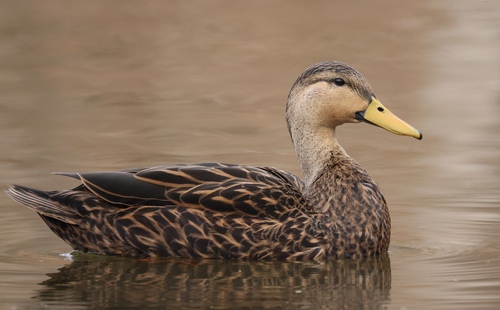
Mottled Duck
Anas fulvigula
The Mottled Duck is the 'homebody' of the southern marshes, a non-migratory beauty that stays loyal to the Gulf Coast all year long. With its subtle coffee-colored plumage and striking blue wing patches, it is a master of camouflage in the tall marsh grasses.
Quick Identification
Size
Length: 44–61 cm (17–24 in); Wingspan: 80–95 cm (31–37 in); Weight: 800–1,200 g (1.8–2.6 lbs)
Colors
Mottled dark brown body with a pale buff head and neck. Males have bright yellow to olive bills, while females have orange or greenish-yellow bills with black spots. Both sexes show a vibrant blue-green wing patch (speculum).
Key Features
- Blue-green wing patch (speculum) lacking white borders
- Plain, unstreaked buff throat and chin
- Small dark spot at the base of the bill (gape)
- Dark tail with buff-edged feathers
When You’ll See Them
Geographic range
Where Does the Mottled Duck Live?
Native to North America, the Mottled Duck is a quintessential coastal species found almost exclusively along the Gulf of Mexico and throughout the Florida peninsula. This non-migratory bird occupies a thin strip of habitat stretching from the shores of Tamaulipas and Veracruz in Mexico, through the Texas and Louisiana marshes, and across the entirety of Florida. Unlike many other waterfowl, these ducks are homebodies, rarely straying from the subtropical wetlands and brackish estuaries of the southern United States.
Basemap © OpenStreetMap contributors
Behavior
Mottled Ducks are primarily dabbling ducks, meaning they feed by tipping their bodies forward in shallow water rather than diving. They are unique among North American ducks for being almost entirely non-migratory, spending their entire lives within a narrow coastal range. They are generally more secretive and wary of humans than the common Mallard, often seen in pairs or small family groups rather than large, noisy flocks.
These birds are highly social with their own kind but can be territorial during the nesting season. They spend much of their day alternating between foraging in the mud for seeds and invertebrates and preening their feathers on secluded banks. Unlike many other waterfowl that fly inland for the winter, the Mottled Duck is a resilient resident of the southern marshes, braving the heat and humidity of the Gulf Coast year-round.
EverydayEarth exclusive
Camera Tips
To capture high-quality footage of a Mottled Duck, camera placement is everything. These birds are low-profile dabblers, so you should mount your camera very low to the ground—ideally between 6 and 12 inches high—facing a muddy shoreline or a shallow pool. This 'duck's-eye view' provides an intimate perspective on their intricate feather patterns and feeding behaviors that a higher, downward-angled mount simply cannot match.
Mottled Ducks are notoriously skittish compared to backyard Mallards. To avoid spooking them, use a camera with a 'no-glow' or 'low-glow' infrared flash for any nighttime or low-light captures, as bright white flashes will likely drive them away from your spot for days. Camouflaging the camera housing with local marsh grasses or reeds can also help it blend into the environment. If you're setting up near a pond, try to find a 'loafing spot'—a flat rock or a log where ducks like to climb out of the water to preen and dry their wings.
Settings-wise, prioritize a fast trigger speed. Waterfowl can move surprisingly quickly when startled or when splashing in the shallows. Use a 'Burst Mode' (3-5 photos per trigger) or a short video clip (15-20 seconds) to ensure you capture the diagnostic features, like the speculum color on the wing, which is often only visible when they stretch or preen. Since they are most active during the golden hours of dawn and dusk, position your camera facing North or South to avoid the direct glare of the sun, which can wash out the subtle brown tones of their plumage.
Similar Species
Species that look similar or are commonly confused with Mottled Duck.
Frequently Asked Questions
Record Mottled Duck at your habitat
Connect a camera to start building your own species record — AI identifies every visitor automatically.