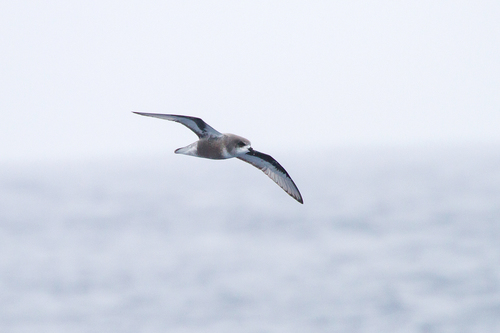
Mottled Petrel
Pterodroma inexpectata
A master of the Pacific skies, the Mottled Petrel travels from the Antarctic ice edge to the Alaskan coast, returning to the hidden forests of New Zealand only to breed in the dark of night.
Quick Identification
Size
Length: 33-35 cm (13-14 in); Wingspan: 74-82 cm (29-32 in); Weight: 300-440 g (10.6-15.5 oz)
Colors
Soft grey upper wings with a dark 'M' marking; white underparts with a signature large dark-grey patch on the belly; white underwings with a bold black diagonal bar.
Key Features
- Prominent dark grey patch on the lower belly
- Bold black diagonal bar running across the white underwing
- Dark 'M' pattern across the upper wings and back
- Short, black, hooked bill with tubular nostrils
When You’ll See Them
Geographic range
Where Does the Mottled Petrel Live?
Native to the South Pacific, the Mottled Petrel is one of the world's most incredible long-distance travelers. Their primary breeding grounds are centered on the islands surrounding New Zealand, specifically around Stewart Island, the Snares, and the Auckland Islands. During the non-breeding season, these birds embark on a massive trans-equatorial migration, heading north across the Pacific to feed in the nutrient-rich waters of the Bering Sea and the Gulf of Alaska, occasionally reaching the edge of the Antarctic ice pack during the southern summer.
Basemap © OpenStreetMap contributors
Behavior
The Mottled Petrel, or Kōrure, is a true 'gadfly' petrel, characterized by its erratic, high-speed flight. They spend the vast majority of their lives over the open ocean, where they are known for their impressive aerial maneuvers, wheeling high into the air before plunging toward the waves. They are highly pelagic and rarely seen from land except during the breeding season when they return to remote islands. At these sites, they are strictly nocturnal, arriving after dusk and departing before dawn to avoid predation by gulls and skuas.
Socially, they are colonial nesters, digging deep burrows in the soil of forested or scrub-covered islands. While they are solitary hunters at sea, they maintain complex social structures within their colonies, using a variety of harsh, 'ti-ti-ti' calls to communicate with mates and neighbors in the dark. Their interaction with humans is minimal due to their remote habitat, though they were once a significant food source for Māori in New Zealand.
EverydayEarth exclusive
Camera Tips
Capturing a Mottled Petrel on camera is a challenge best suited for those living on or visiting specific New Zealand islands or coastal conservation areas. Because these birds are strictly nocturnal on land, an AI-powered camera with high-quality Infrared (IR) night vision is essential. Standard white-light flashes should be avoided as they can disorient the birds and disrupt their breeding behavior.
The best placement for a camera is near known burrow entrances. Position the camera low to the ground—about 6 to 12 inches high—angled slightly upward to catch the bird as it lands or exits its burrow. Since they are clumsy on land and often 'crash-land' through the canopy before scrambling to their holes, a wide-angle lens is helpful to capture the action. Do not use food bait, as this can attract predators like rats or cats that threaten the colony; instead, focus on natural pathways through the scrub.
Set your camera to video mode or high-speed burst. These birds move surprisingly fast even on the ground and can disappear into a burrow in seconds. If you are using a trail camera in a high-moisture environment like a New Zealand rainforest, ensure you use plenty of desiccant packets inside the housing to prevent lens fogging during the humid nights. The peak time for activity is usually 1 to 3 hours after sunset and just before dawn.
Similar Species
Species that look similar or are commonly confused with Mottled Petrel.
Frequently Asked Questions
Record Mottled Petrel at your habitat
Connect a camera to start building your own species record — AI identifies every visitor automatically.