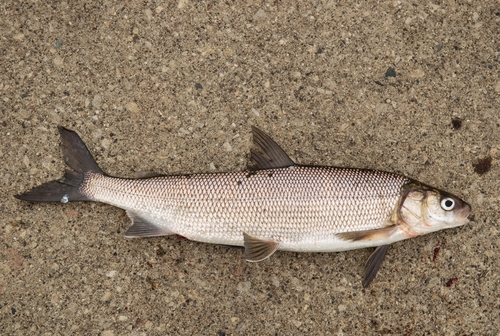
Lake Whitefish
Coregonus clupeaformis
Meet the 'silver of the Great Lakes.' The Lake Whitefish is a cold-water specialist recognized by its unique humpbacked profile and its deep-rooted history in North American freshwater culture.
Quick Identification
Size
Typically 30-65 cm (12-26 inches) in length and weighing 0.9-2.3 kg (2-5 lbs); trophy specimens can exceed 75 cm and 9 kg.
Colors
Silvery-white sides with a dark olive-to-brownish back; belly is pure white. Fins are mostly clear or slightly dusky, lacking the spots found on trout or salmon.
Key Features
- Small head with a distinctive 'humpback' appearance
- Subterminal mouth where the snout overhangs the lower jaw
- Two small flaps of skin between the nostrils
- Deeply forked tail and a small adipose fin
When You’ll See Them
Geographic range
Where Does the Lake Whitefish Live?
The Lake Whitefish is a quintessentially North American species, natively distributed across the vast majority of Canada, from the Atlantic provinces to the Arctic drainage systems. In the United States, they are most famously associated with the five Great Lakes, but their range also extends into the deep glacial lakes of New England, New York, and the Upper Midwest. While they are a northern specialist, some populations have been successfully introduced to high-altitude reservoirs in the western United States to provide sport fishing opportunities.
Basemap © OpenStreetMap contributors
Behavior
Lake Whitefish are social, schooling fish that thrive in the cold, oxygen-rich depths of North America's largest freshwater lakes. They are highly sensitive to water temperature, often following the 'thermocline' to remain in waters cooler than 13°C (55°F). For most of the year, they are benthic cruisers, moving in large groups along the lake bottom to scavenge for invertebrates.
Their behavior changes seasonally, most notably during the late autumn spawning season. As water temperatures drop, schools migrate from the depths to shallow rocky shoals or river mouths. This is a period of high activity and is often the only time they are seen in waters less than 25 feet deep. Unlike many other freshwater fish, they are active throughout the winter and are a primary target for ice anglers.
While generally shy and easily spooked by sudden movements or shadows, they are curious about light and vibrations. In the Great Lakes, they have adapted their feeding behavior over decades, shifting their diet in response to invasive species like zebra mussels, showing a remarkable level of ecological resilience.
EverydayEarth exclusive
Camera Tips
Capturing Lake Whitefish requires a specialized underwater camera setup, as they rarely surface and prefer deep water. For backyard lakefronts or docks, mount a submersible camera to a dock piling or a weighted tripod on the lakebed. Position the lens to face a 'transition zone'—where a sandy bottom meets a rocky reef or a steep drop-off—at depths of 15 to 30 feet. During the spawning run in late fall, you can move your camera into much shallower water (3-8 feet) near rocky shorelines.
Lighting is the biggest challenge when filming whitefish. Standard white lights can spook them or attract too much particulate matter (backscatter) in the water. Instead, use infrared (IR) or very dim 'moonlight' LEDs. Because they are schooling fish, set your camera to record 30-second video clips rather than still photos. This allows you to witness the rhythmic, sweeping motion of the school as they cruise past the lens, which is much more visually impressive than a single fish.
To keep the school in front of your camera longer, consider using a scent or bait attractant where local regulations allow. A small mesh bag filled with crushed salmon eggs or salted minnows tied just outside the camera's field of view can lure them into the 'sweet spot.' Ensure your camera housing is camouflaged with dark, non-reflective tape, as the flash of silver from a metal housing can drive away more cautious adults. In winter, an underwater camera dropped through an ice hole is the ultimate tool for observing their delicate feeding strikes.
Similar Species
Species that look similar or are commonly confused with Lake Whitefish.
Cisco
Has a terminal mouth (jaws meet evenly) and a slimmer, less humpbacked profile than the Lake Whitefish.
Mountain Whitefish
Found in western drainages; has a more cylindrical body and a shorter dorsal fin base.
Round Whitefish
Much more cylindrical in cross-section and possesses only a single flap of skin between the nostrils instead of two.
Frequently Asked Questions
Record Lake Whitefish at your habitat
Connect a camera to start building your own species record — AI identifies every visitor automatically.