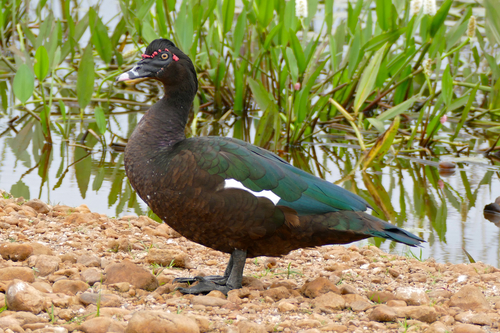
Muscovy Duck
Cairina moschata
Meet the 'perching duck' of the Americas. With their unmistakable red-masked faces and quiet, hissing charm, Muscovy Ducks are a fascinating and hardy addition to any backyard water feature.
Quick Identification
Size
Length: 64–86 cm (25–34 in); Wingspan: 137–152 cm (54–60 in); Weight: 2.7–6.8 kg (6–15 lb)
Colors
Wild birds are iridescent black with white wing patches; feral/domestic birds vary from pure white to mottled black and white. Most notable for red fleshy caruncles on the face.
Key Features
- Red fleshy caruncles around the eyes and beak
- Broad, flat tail
- Sharp claws on webbed feet for perching
- Heavy, low-slung body with a distinct waddle
When You’ll See Them
Geographic range
Where Does the Muscovy Duck Live?
Native to the tropical and subtropical reaches of the Americas, the Muscovy Duck's original home stretches from the Rio Grande Valley in Texas down through Mexico and Central America to the lush wetlands of Argentina and Uruguay. While they thrive in these warm, forested river basins, their hardy nature has allowed them to establish thriving feral populations far beyond their native borders. Today, you can commonly spot these ducks in suburban neighborhoods across Florida, the Gulf Coast, and even as far afield as Australia and parts of Europe.
Basemap © OpenStreetMap contributors
Behavior
In suburban environments, they often lose their fear of humans and can become quite bold. They are excellent parents, with mothers being fiercely protective of their large broods. Despite their heavy appearance, they are surprisingly powerful flyers, though they prefer to spend their time foraging on the ground or swimming in shallow waters.
EverydayEarth exclusive
Camera Tips
To capture the best footage of a Muscovy Duck, place your camera at a low angle, roughly 12 to 18 inches off the ground. These ducks are ground-heavy and low-slung, so a 'worm's-eye view' provides a majestic perspective of their size and the intricate textures of their facial caruncles. If you have a backyard pond, position the camera near a preferred entry or exit point on the bank, as they often spend time preening themselves immediately after leaving the water.
Using a lure can be very effective for centering them in your frame. A shallow tray of cracked corn, sunflower seeds, or mealworms will keep them occupied long enough for your camera to trigger and record several high-quality sequences. Because they are social, a single visitor often leads to a whole flock, so ensure your camera's 'recovery time' or 're-trigger' setting is set to the shortest possible interval to capture the group dynamics.
Timing is critical for lighting. Muscovy Ducks are most active in the early morning and late afternoon. During these times, their iridescent black feathers can show off brilliant green and purple highlights that are often lost in the harsh midday sun. If your camera allows for video, try to capture their social interactions; their head-bobbing displays are a signature behavior that looks fantastic on film.
Don't forget to look up! Because they are perching ducks, you might find them roosting on low tree branches or fence posts. If you notice a particular spot where they like to hang out, mounting a camera on a nearby tree trunk facing the branch can provide unique 'aerial' shots that many people don't realize are possible with a duck species.
Similar Species
Species that look similar or are commonly confused with Muscovy Duck.
Frequently Asked Questions
Record Muscovy Duck at your habitat
Connect a camera to start building your own species record — AI identifies every visitor automatically.