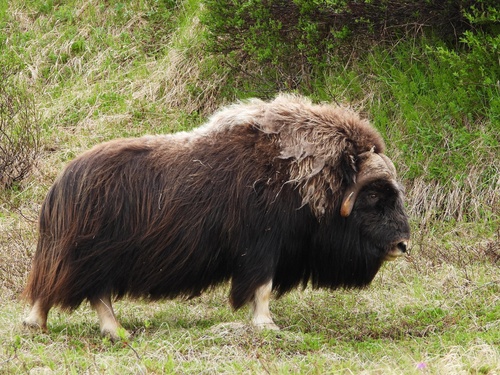
Muskox
Ovibos moschatus
A shaggy relic of the Ice Age, the muskox is a testament to survival in the world's harshest climates. Known as 'the bearded one' by the Inuit, these powerful herbivores are famous for their formidable horns and unbreakable defensive circles.
Quick Identification
Size
Length: 1.9–2.3 m (6.2–7.5 ft); Shoulder height: 1.1–1.5 m (3.6–4.9 ft); Weight: 180–410 kg (400–900 lbs)
Colors
Dark chocolate brown to black shaggy coat; creamy-white 'saddle' patch on the back; whitish 'stockings' on the lower legs.
Key Features
- Massive, down-curved horns that form a solid bony 'boss' across the forehead
- Double-layered coat with long guard hairs reaching nearly to the ground
- Pronounced hump at the shoulders and a short, thick neck
- Broad, rounded hooves designed for traversing both snow and rocky terrain
When You’ll See Them
Geographic range
Where Does the Muskox Live?
The muskox is native to the high Arctic regions of Northern Canada and Greenland. While they faced significant population declines in the past, successful reintroductions have established wild populations in Alaska, the Taimyr Peninsula in Russia, and the mountainous regions of Norway and Sweden. These resilient mammals are strictly limited to the northernmost latitudes, rarely venturing south of the treeline.
Basemap © OpenStreetMap contributors
Behavior
Muskoxen are highly social Ice Age survivors that live in herds of 10 to 20 individuals, though groups can swell to over 70 in the winter. They are famous for their unique 'phalanx' defense; when threatened by wolves or bears, the adults form a tight outward-facing circle or line with their horns pointed toward the predator, effectively shielding the calves tucked safely in the center.
During the late summer rut, males become intensely territorial and emit the potent, musky odor that gives the species its name. Competition for dominance involves dramatic head-butting displays, where bulls charge at one another from distances of 50 feet and collide head-on with incredible force. Despite their sedentary appearance, they are surprisingly agile and can run at speeds up to 25 mph if provoked.
EverydayEarth exclusive
Camera Tips
Capturing a muskox on a trail camera requires equipment that can withstand the most punishing environments on Earth. Because the Arctic is notorious for killing standard alkaline batteries, lithium batteries or a high-quality external solar-powered battery pack are essential requirements. Position your camera about 3 to 4 feet off the ground—muskoxen are shorter than bison, and their massive coats can often obscure the view if the camera is angled too low.
Strategic placement is key in the vast tundra where there are few trees. Look for 'rubbing posts' such as large, isolated boulders or thickets of stunted arctic willow. During the spring shed, muskoxen frequently rub against these surfaces to lose their underwool (qiviut), leaving behind clumps of fibers that are a surefire sign of their presence. In winter, focus your efforts on wind-swept ridges where the wind blows snow clear, as herds congregate there to find accessible forage.
Be mindful of the 'Midnight Sun' and 'Polar Night' cycles. Ensure your camera's sensor has high dynamic range, as the contrast between the dark coat of the muskox and the bright white of the surrounding snow can lead to overexposed or underexposed shots. If you are tracking a herd, use 'Time Lapse' mode with a 5-10 minute interval; this allows you to capture the herd's movement across the landscape even if they don't pass directly in front of the PIR sensor. Finally, ensure your mount is extremely sturdy—a curious 800-pound bull may use your camera as a scratching post, which can easily snap flimsy plastic mounts.
Similar Species
Species that look similar or are commonly confused with Muskox.
Frequently Asked Questions
Record Muskox at your habitat
Connect a camera to start building your own species record — AI identifies every visitor automatically.