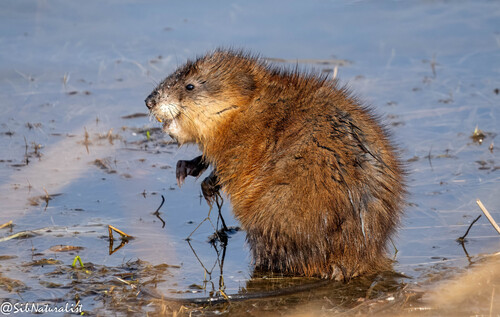
Muskrat
Ondatra zibethicus
The muskrat is a master of the marsh, a resilient and resourceful architect that transforms every waterway it touches into a thriving habitat.
Quick Identification
Size
16-28 inches (40-70 cm) in length; 1.5-4.4 lbs (0.6-2 kg) in weight
Colors
Glossy dark brown to reddish-brown upper fur; silvery-grey or buff underbelly; black scaly tail
Key Features
- Vertically flattened, rudder-like tail
- Small ears nearly hidden by thick fur
- Valved nostrils and ears for underwater activity
- Prominent, orange incisors
When You’ll See Them
Geographic range
Where Does the Muskrat Live?
The muskrat is a quintessential North American species, natively spanning the vast majority of the continent from the northern reaches of Canada and Alaska down to the southern United States. While they are absent from the driest parts of the American Southwest and the tip of Florida, they have successfully colonized almost every other permanent waterway in their home range. In the 20th century, they were introduced to Europe and Northern Asia for the fur trade, where they have since established massive, self-sustaining populations across the Palearctic, thriving in temperate and boreal climates alike.
Basemap © OpenStreetMap contributors
Behavior
Muskrats are highly industrious semiaquatic rodents that function as the landscape architects of the wetlands. They are famous for building conical 'lodges' out of cattails and mud, though in many areas, they prefer to excavate complex burrow systems into the banks of ponds and slow-moving streams. These burrows usually feature underwater entrances that lead to dry chambers above the water level, providing safety from terrestrial predators.
While they are primarily crepuscular, active mostly during the twilight hours of dawn and dusk, muskrats can be seen during the day, especially in quiet, undisturbed habitats. They are non-hibernating and remain active throughout the winter, often swimming under the ice to reach submerged food sources. Despite their cute appearance, they are fiercely territorial and will defend their home range from other muskrats using scent markings from their musk glands.
EverydayEarth exclusive
Camera Tips
To successfully capture a muskrat on your trail camera, you need to think like a water-dweller. Look for 'runs' or 'slides'—these are smooth, muddy paths at the water's edge where the muskrat repeatedly enters and exits the water. Placing your camera on a stake or a nearby tree about 6 to 10 inches off the ground is ideal, as muskrats have a very low profile. Angle the camera parallel to the shoreline rather than straight out at the water to maximize the time the animal stays in the frame as it travels the bank.
Muskrats often use 'feeding platforms,' which are flat rocks, logs, or matted clumps of vegetation where they bring their food to eat safely. If you find a pile of chewed-up cattails or empty mussel shells on a half-submerged log, you have found the perfect spot for a camera setup. Because muskrats are active during low-light hours, ensure your camera has a high-quality infrared flash that won't blow out the details of their dark, wet fur at close range.
Video mode is highly recommended for muskrats. Their swimming motion is distinct—a rhythmic, side-to-side undulation of the tail—which is fascinating to watch in high definition. If you are using photo mode, set a 3-shot burst with a minimal trigger delay. Muskrats are surprisingly quick when they feel exposed, and a single photo might only capture a splash or a tail-flip.
During the winter, look for 'push-ups,' which are small mounds of vegetation pushed up through holes in the ice. These serve as breathing holes and resting spots. Placing a camera near a push-up can yield incredible winter footage that most people never see. While they aren't traditionally 'baited,' a few slices of fresh apple or a piece of sweet corn placed on a feeding log can sometimes encourage them to linger long enough for a perfect shot.
Similar Species
Species that look similar or are commonly confused with Muskrat.
Frequently Asked Questions
Record Muskrat at your habitat
Connect a camera to start building your own species record — AI identifies every visitor automatically.