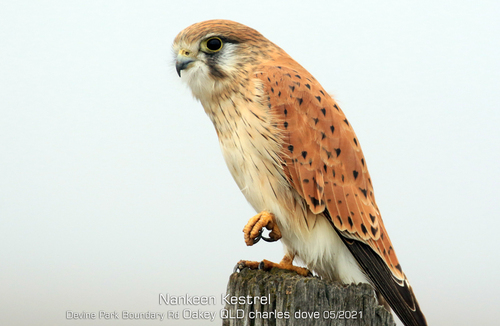
Nankeen Kestrel
Falco cenchroides
The Nankeen Kestrel is Australia's master of the stationary flight. With its cinnamon plumage and piercing gaze, this small but mighty falcon is a common and charismatic sight in backyards and open fields across the continent.
Quick Identification
Size
Length: 28-35 cm (11-14 in); Wingspan: 66-78 cm (26-31 in); Weight: 121-255 g (4.3-9.0 oz)
Colors
Pale cinnamon-rufous upperparts with black flecks; creamy-white underparts with dark streaks; males have a grey head and tail while females are rufous-headed.
Key Features
- Signature 'wind-hovering' flight pattern
- Long, narrow wings with pointed tips
- Black subterminal band on the tail
- Small, hooked beak with a yellow cere
- Distinctive dark 'tear' stripe below the eye
When You’ll See Them
Geographic range
Where Does the Nankeen Kestrel Live?
The Nankeen Kestrel is native to the continent of Australia, where it is found across the entire mainland and Tasmania. Its range extends north through the Torres Strait into New Guinea and the Lesser Sunda Islands of Indonesia. While they are primarily residents in the southern parts of their range, some populations are known to be nomadic or partially migratory, moving toward northern Australia during the winter months to follow seasonal food abundances.
Basemap © OpenStreetMap contributors
Behavior
The Nankeen Kestrel is one of Australia’s most recognizable birds of prey, often seen suspended motionless in mid-air against a clear blue sky. This behavior, known as 'wind-hovering,' allows the kestrel to keep its head perfectly still while scanning the ground for the slightest movement of prey. Unlike larger falcons that rely on high-speed strikes, the kestrel is a patient observer, frequently utilizing power lines, fence posts, and dead trees as vantage points for its 'sit-and-wait' hunting strategy.
These falcons are highly adaptable and have benefited from human land clearing, which creates the open grasslands they prefer for hunting. While they are generally solitary or found in pairs, they are surprisingly tolerant of urban environments. You may spot them nesting on the ledges of high-rise buildings or hunting along the grassy verges of busy motorways. Their call is a distinctive, high-pitched chatter that is most frequently heard during the breeding season or when defending their territory from other raptors.
EverydayEarth exclusive
Camera Tips
To capture high-quality footage of a Nankeen Kestrel, position your AI camera to overlook a prominent, high-altitude perch. These birds love 'scout spots'—place a vertical T-post or a bare, sturdy branch about 2-3 meters high in an open area of your yard. Ensure the camera is mounted slightly higher than or level with the perch to get eye-level shots, as kestrels will spend significant time here surveying the ground for insects and lizards.
Because kestrels are visually oriented and cautious, camera placement is everything. Avoid placing the camera where it will be buffeted by wind, as the movement can trigger false alerts and might make the bird feel the perch is unstable. Use a high shutter speed or 'Action' setting if your camera allows, as their movements can be incredibly quick when they spot prey and drop suddenly from their perch. If you are using an AI-powered camera, set the motion detection zone to include the air space just above the perch to catch their elegant landings.
While they won't visit a bird feeder for seeds, a kestrel-friendly backyard is one that supports a healthy ecosystem. Avoid using pesticides; a lawn that hosts grasshoppers and skinks is the ultimate natural lure. Early morning and late afternoon provide the best light for capturing their cinnamon plumage. During the spring nesting season (August to December), keep an eye out for pairs; if you have large trees with hollows or even high ledges on your house, they may investigate these as potential nest sites, offering a rare chance for long-term observation.
Similar Species
Species that look similar or are commonly confused with Nankeen Kestrel.
Brown Falcon
Much larger and darker with broader wings; it lacks the kestrel's frequent hovering behavior.
Australian Hobby
Darker, slate-grey upperparts and much faster, more direct flight; primarily hunts small birds in mid-air.
Black-shouldered Kite
Also hovers, but is easily distinguished by its bright white plumage and prominent black wing patches.
Frequently Asked Questions
Record Nankeen Kestrel at your habitat
Connect a camera to start building your own species record — AI identifies every visitor automatically.