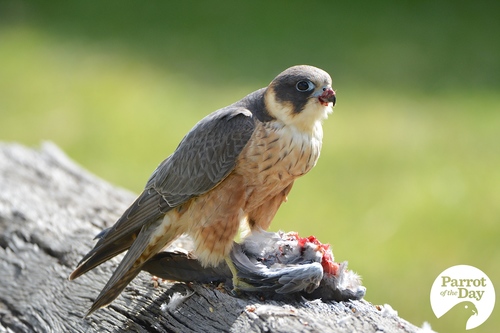
Australian Hobby
Falco longipennis
A master of aerial acrobatics, the Australian Hobby is a pint-sized powerhouse that brings the thrill of the high-speed hunt to suburban backyards. With its scythe-like wings and lightning-fast agility, it is one of the most impressive raptors to spot on a trail camera.
Quick Identification
Size
Length: 30–35 cm (12–14 in); Wingspan: 70–90 cm (28–35 in); Weight: 175–300 g (6–11 oz)
Colors
Upperparts are slate-grey to dark charcoal; underparts are rich rufous with fine dark streaks. Features a distinct white throat and buff 'half-collar'.
Key Features
- Long scythe-shaped wings that extend past the tail when perched
- Dark charcoal 'hood' and mask contrasting with a white throat
- Rapid, flickering wingbeats and extreme aerial agility
- Small, stocky falcon build with a short, hooked beak
When You’ll See Them
Geographic range
Where Does the Australian Hobby Live?
Native to the Australian continent, the Australian Hobby is a widespread resident across mainland Australia and can be found in almost every habitat except the densest rainforests. While they are common across the Australian interior and coastlines, they are also found throughout the islands of Indonesia, New Guinea, and occasionally the Solomon Islands, particularly during the winter months when southern populations migrate north. This adaptable falcon is equally at home in the arid outback as it is in the lush coastal suburbs of major cities.
Basemap © OpenStreetMap contributors
Behavior
The Australian Hobby is one of the most athletic and daring predators in the suburban sky. Unlike many larger raptors that soar lazily on thermals, the Hobby is a pursuit specialist, often seen darting between trees or buildings at high speeds to surprise its prey. They are primarily diurnal but are famously active during the crepuscular hours—dawn and dusk—when their favorite prey, small birds and large insects, are most active.
In urban environments, these falcons have adapted remarkably well to human presence. They often use tall man-made structures like radio towers, power lines, or skyscrapers as vantage points for hunting. While generally solitary or seen in breeding pairs, they are fiercely territorial and will vocalize with a rapid, shrill 'kee-kee-kee' call to ward off intruders, including much larger birds like magpies or hawks.
EverydayEarth exclusive
Camera Tips
Capturing an Australian Hobby on a backyard camera requires targeting their favorite perches rather than ground-level activity. These falcons rarely descend to the ground except to bathe, so focus your camera on high, exposed branches or 'stags' (dead trees) that offer a 360-degree view of your garden. If you have a tall birdbath on a pedestal, this is your best chance for a close-up; Hobbies are known to visit water sources to cool off and clean their feathers after a high-energy hunt.
Because the Hobby is incredibly fast, use a camera with a high trigger speed (0.2 seconds or less) and a fast recovery time to ensure you don't just catch a blur of feathers. If your camera settings allow, increase the shutter speed or use 'burst mode' to capture the rapid wingbeats. Positioning your camera to face away from the sun—usually south in the southern hemisphere—will help avoid lens flare during their peak activity periods at dawn and dusk, ensuring the deep rufous colors of their chest are clearly visible.
Avoid using traditional baits, as Hobbies only hunt live prey. Instead, focus on creating a habitat that attracts their food source—small passerine birds. A well-placed camera near a bird feeder (positioned to watch the surrounding trees rather than the feeder itself) can capture a Hobby as it waits in ambush. During the summer months, they are often attracted to large hatches of cicadas or dragonflies, so keep your camera active near open spaces where these insects congregate.
Similar Species
Species that look similar or are commonly confused with Australian Hobby.
Peregrine Falcon
Larger and bulkier with a broader facial mask and horizontally barred underparts rather than a rufous wash.
Brown Falcon
Larger with longer legs, a slower wingbeat, and lacks the Hobby's distinct rufous underbelly and extreme aerial speed.
Nankeen Kestrel
Smaller with a pale cinnamon back and a characteristic habit of hovering in one spot, which Hobbies rarely do.
Frequently Asked Questions
Record Australian Hobby at your habitat
Connect a camera to start building your own species record — AI identifies every visitor automatically.